
Top Video Laryngoscope Options: Ranking Unicorn's Rigid and Flexible Models for Difficult Airways
Top Video Laryngoscope Options: Ranking Unicorn's Rigid and Flexible Models for Difficult Airways
Introduction
Direct answer: Unicorn's difficult-airway portfolio contains three video laryngoscope models — the rigid BMS-FA, the rigid BMS-YA and the flexible BMR. Ranked by suitability for difficult airway management in hospital settings, the BMS-FA takes first place because its 304 stainless steel blade and aluminium alloy handle provide the durability and mechanical control that repeated intubation attempts demand. The BMR flexible laryngoscope ranks second, on the strength of its 23.51 LP/mm resolution, greater-than-80° field of view and above-800 Lux illuminance. The BMS-YA ranks third overall but first for high-volume, hygiene-focused settings, where its lighter PC plastic blade is the practical advantage. That order is not fixed: operating room, emergency ward and ICU each weight these criteria differently, and the ranking shifts with them.
This ranking is written for the people who have to make that match on paper before anyone touches a device: anesthesiologists specifying departmental equipment, ICU and emergency clinicians defining capability requirements, biomedical engineering teams evaluating reprocessing and durability, and procurement managers running hospital equipment procurement or centralized tenders. It is a device-fit ranking, not a quality ranking. All three models are built for anesthesiology and respiratory medicine and sit on the same certification base; what separates them is how they reach the glottis, how much optical information they return, and how they survive daily hospital use.
The aim here is narrow and practical. Unicorn's application documentation states the job these devices are meant to do — real-time high-definition visual laryngeal exposure guidance and accurate endotracheal intubation assistance, with the explicit goals of reducing the intubation failure rate and reducing laryngeal tissue injury. The question this article answers is which of the three models does that job best in which room, and why.
Problem Definition: What a Difficult Airway Actually Demands From a Device
A difficult airway is the clinical situation in which the clinician cannot obtain an adequate view of the glottis, or cannot complete tracheal intubation, using the routine approach. Two consequences dominate the discussion afterwards: an intubation that fails or takes repeated attempts, and tissue injury to the larynx caused by the attempts themselves. Those are precisely the two outcomes Unicorn's application data names as the purpose of its video laryngoscopes — guidance of laryngeal exposure in real time and support for accurate tube placement, in order to reduce the intubation failure rate and laryngeal tissue injury.
The first outcome is a view problem. A video laryngoscope moves the clinician's eye from the mouth to a screen, so the quality of what appears on that screen — resolution, field of view, depth of field and illumination — decides how much anatomical information is available when the airway is not straightforward. The BMS-FA and BMS-YA publish a resolution of at least 3.72 lp/mm, a field of view of at least 60° and an observation depth of field of 20–100 mm. The BMR publishes 23.51 LP/mm, a field of view above 80°, a depth of field from 5 mm to 100 mm and illuminance above 800 Lux. Those are different optical classes, and they suit different airways.
The second outcome is a mechanics and durability problem. Laryngeal tissue injury is associated with repeated and forceful instrumentation, so the blade or insertion path matters as much as the camera. A rigid blade that can be used to displace anatomy gives the clinician mechanical control; a flexible instrument follows a curved path where a straight blade cannot be aligned. Blade material then decides how that instrument behaves across hundreds of uses and disinfection cycles: the BMS-FA uses a 304 stainless steel blade, the BMS-YA uses a PC plastic blade, and the BMR uses TPU/PPSU construction.
For procurement teams, the problem is compounded by the way hospitals buy. Unicorn's application documentation lists the relevant project types directly: hospital equipment procurement, clinical anesthesia equipment upgrade, emergency medical system construction, and batch tendering for medical device centralized purchasing. In a tender, a department usually has to name preferred models, justify them against scenario requirements, and defend the accessories and consumables that come with them. Choosing a single model for every room is the common shortcut — and it is also the most common source of either over-specification or a capability gap in the ICU.
Industry Background: A Widening Device Mix Inside a Consolidating Market
The global video laryngoscope market was estimated at USD 784.66 million in 2024 and is projected to reach USD 2.80 billion by 2033, according to Grand View Research. That figure sits inside a broader and differently defined laryngoscope market: Future Market Insights valued the global laryngoscopes market (all types) at USD 508.5 million in 2024, with a forecast growth rate of 7.2% compound annual growth through 2034. The two estimates diverge because one counts video systems only and the other counts direct and video laryngoscopes together — a reminder that market size figures should always be read with their definitions attached.
Two structural facts in the same 2024 data are directly relevant to how Unicorn's three models should be ranked. First, the reusable video laryngoscope segment held the largest revenue share at 77.68% — the market still pays for instruments designed to be reused, serviced and reprocessed rather than discarded after one case. Second, the rigid video laryngoscope segment dominated the product market with a 60.42% revenue share. In other words, the rigid form factor remains the workhorse, and the flexible video laryngoscope is the specialist complement rather than the default. Regionally, North America dominated with a 37.77% revenue share in 2024, which is consistent with the emphasis large teaching hospitals place on documented difficult-airway equipment.
Regulation shapes the buying conversation as much as clinical preference. Medical devices such as video laryngoscopes must comply with EU MDR 2017/745 and typically require ISO 13485 certification for the Quality Management System, as documented by Emergo by UL. Unicorn's application documentation reflects the same expectation on the clinical side, listing compliance with the ISO 13485 medical device quality management system as a special requirement for its hospital use scenarios. Jiangsu Unicorn Electronic Technology Co. Ltd. holds ISO9001 and ISO13485 quality management system certifications and has obtained FSC and CE certification for its medical devices.
Cost is the fourth background variable. The cost of reusable video laryngoscopes ranges from USD 1,000 to USD 8,000, while traditional single-use laryngoscopes cost approximately USD 18, per Medtronic data cited through Grand View Research. That gap is the reason reusable video laryngoscopes are evaluated like capital equipment — as a multi-year asset with blades, sleeves, batteries and docks attached — rather than as a per-case consumable. Disposable laryngoscope blades and reusable blade sleeves still appear in the accessory list, because a reusable platform in practice is a hybrid system.
Competitively, the category is populated by well-known international and Chinese suppliers. Key global players in the video laryngoscope market include Verathon, Medtronic, Ambu A/S, KARL STORZ and Tuoren Group, according to Expert Market Research and Grand View Research. Unicorn enters that field as a manufacturer with a defined industrial base rather than as a trading intermediary: a 40,000-square-metre manufacturing facility, an annual production capacity of 12,000 units, an R&D team of over 20 engineers, BSL-1 and BSL-2 R&D centers, and modern workshops covering 3D printing, CNC precision manufacturing, injection molding and sterile production environments. Exports account for 70% of total sales, with markets worldwide. For a hospital or distributor, that combination is what makes a three-model portfolio credible — the ranking below is only useful if all three models can actually be produced, certified and supported.
The Ranked Options: Unicorn's Rigid and Flexible Video Laryngoscopes
The ranking below uses four criteria, weighted for difficult airway management rather than for routine intubation. They are, in order: (1) mechanical control and material durability in repeated use; (2) optical clarity, meaning resolution, field of view, depth of field and illumination; (3) portability and power continuity for bedside and transport deployment; and (4) scenario coverage together with accessory and consumable fit. Certification is not a ranking criterion because all three models share the same certification and quality-system basis.
Rank 1 — BMS-FA: The Rigid Workhorse for Operating Room and Emergency Difficult Airways
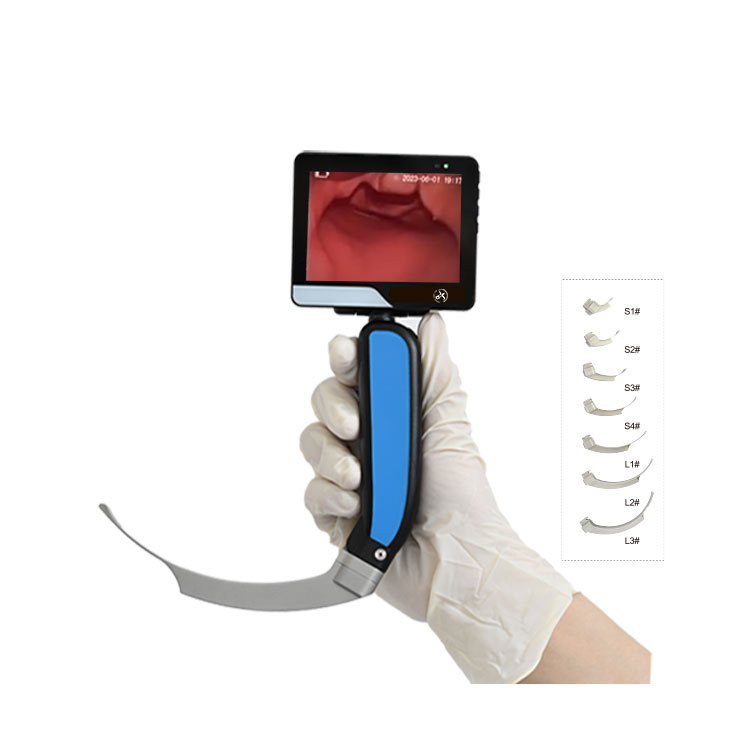
The BMS-FA is a video laryngoscope intended for use in anesthesiology and respiratory medicine. Its defining feature is the blade: 304 stainless steel, paired with an aluminium alloy handle. Optical performance is specified as a resolution of at least 3.72 lp/mm, a field of view of at least 60° and an observation depth of field of 20–100 mm. Power is supplied by a DC 3.7 V battery with a capacity of 3400 mAh or above.
It ranks first because difficult airway management in the operating room is still, most of the time, a problem of mechanical control under time pressure. A stainless steel blade gives the clinician a rigid lever for laryngeal manipulation while the camera provides the view — the combination that most directly serves the stated goal of reducing both intubation failure and laryngeal tissue injury. The material choice also answers the procurement question that follows every specification meeting: how the instrument will behave after repeated use and repeated disinfection cycles in a department that intubates every working day. A stainless steel blade and an aluminium alloy handle are the most durable combination in this portfolio, which is why the BMS-FA is the natural default for high-frequency operating room and emergency airway work.
Its limit is the same as its strength. A rigid blade assumes that a usable line of sight can be created through positioning and laryngeal manipulation. Where anatomy prevents that, rigidity stops being an advantage.
Rank 2 — BMR: The Flexible Optical Specialist
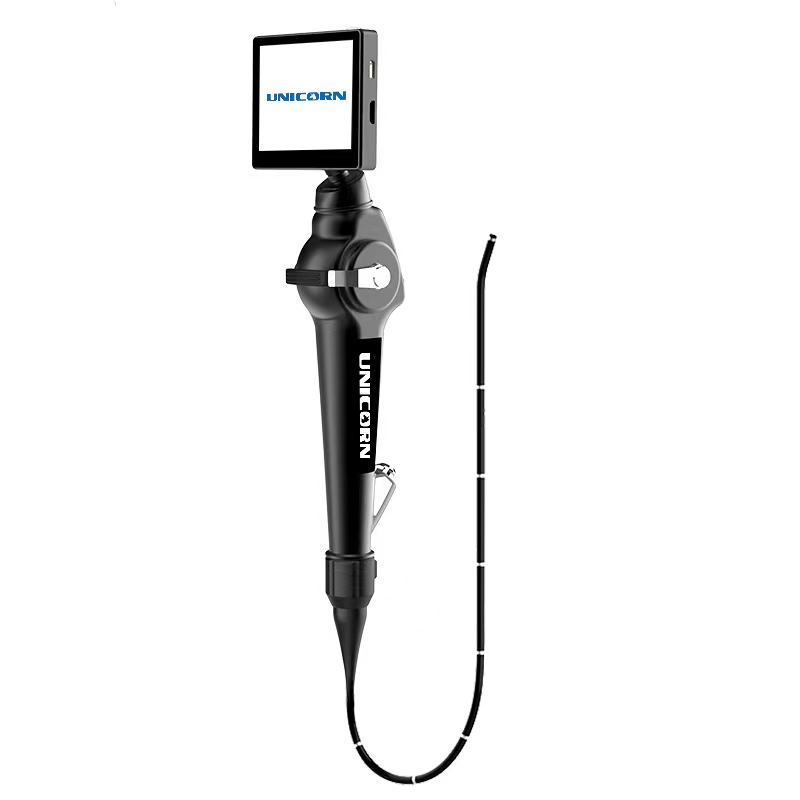
The BMR is a video flexible laryngoscope designed for anesthesiology and respiratory medicine, constructed from TPU/PPSU. Its published specifications are markedly different from the rigid models: a resolution of 23.51 LP/mm, a field of view greater than 80°, a depth of field from 5 mm to 100 mm, and illuminance above 800 Lux.
On pure optics, the BMR is the strongest instrument of the three. A field of view beyond 80° is wider than the 60° specified on the rigid models, the depth of field begins closer at 5 mm rather than 20 mm, and the illuminance specification above 800 Lux speaks directly to the visibility problem that makes difficult airways difficult. That is why the BMR ranks second overall despite leading on the criteria most associated with image quality: the flexible form factor serves a narrower but higher-complexity subset of cases, and it requires a different insertion technique from a rigid blade.
Practically, the BMR is the model to reach for when the question is no longer "which rigid blade" but "how do we see around a curve." In an ICU, where patients are often intubated at the bedside with limited repositioning, and in complex anatomy where a straight blade cannot be aligned with the glottis, the flexible instrument's optical margin is the reason it exists in the portfolio. Procurement teams should therefore treat the BMR as a capability purchase rather than a volume purchase: it is bought to close a gap, not to replace the rigid models.
Rank 3 — BMS-YA: The High-Volume, Hygiene-First Rigid Option
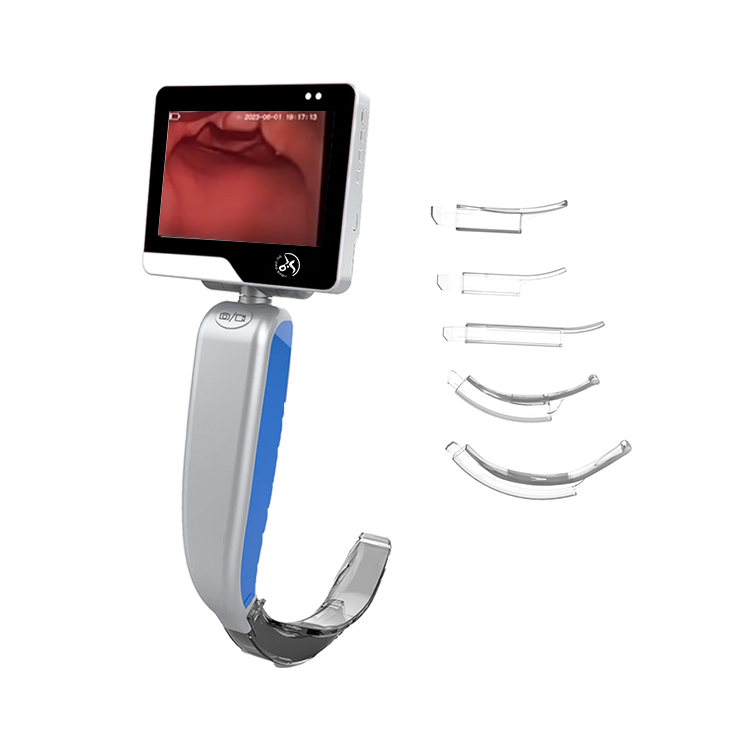
The BMS-YA is also a video laryngoscope for anesthesiology and respiratory medicine, and it shares the BMS-FA's optical and power platform exactly: resolution at least 3.72 lp/mm, field of view at least 60°, observation depth of field 20–100 mm, DC 3.7 V supply and a battery capacity of 3400 mAh or above. What differs is the blade material — polycarbonate (PC) plastic — and the handle, which remains aluminium alloy.
It ranks third on the difficult-airway criteria set above, because a polymer blade offers less mechanical assistance than stainless steel when the clinician needs to displace tissue. But it ranks first in the settings where that assistance is rarely needed and throughput matters more: emergency wards with continuous intubation load, departments standardising on disposable laryngoscope blades with reusable blade sleeves, and infection-control programmes that prefer a lighter, replaceable blade. Unicorn's application documentation supports this pattern directly, listing disposable laryngoscope blades and reusable blade sleeves among the matched equipment for its laryngoscope platform, alongside a power adapter, charging dock, high-capacity spare battery, data export USB flash drive, medical cart bracket and external medical monitor.
Read correctly, the BMS-YA is not the third-best device in an absolute sense. It is the third-ranked device for difficult airways, and the first choice for routine, high-volume, hygiene-driven airway management on the same optical platform as the top-ranked model.
Step-by-Step Breakdown: Matching a Model to a Room
Rankings are useful only when they translate into a repeatable selection process. The six steps below are the sequence a clinical and procurement team can run before writing a specification or a tender line item.
- Define the airway problem, not the product. Start with the case mix in the room you are equipping — anticipated difficult intubation, unanticipated rescue, routine rapid-sequence induction, or bedside ICU intubation — and write down which of the two stated goals is at risk, failed intubation or laryngeal tissue injury.
- Decide rigid or flexible visualization. If a usable line of sight can be created with positioning and laryngeal manipulation, a rigid blade is the efficient choice. If the airway requires following a curve or bedside positioning is restricted, the flexible BMR is the instrument that addresses the constraint. This single decision already separates the ranking.
- Weight the optical specifications against the case mix. Compare resolution, field of view and depth of field numerically. The rigid models' at-least-3.72 lp/mm, at-least-60° and 20–100 mm figures are the baseline; the BMR's 23.51 LP/mm, above-80°, 5–100 mm and above-800 Lux figures define the higher-clarity tier.
- Assess blade material against your reprocessing and replacement cycle. 304 stainless steel for durability in repeated use, PC plastic where a lighter replaceable blade and disposable blade workflow fit the department's infection-control policy, TPU/PPSU construction for the flexible instrument.
- Verify power and portability together. The rigid models run on a DC 3.7 V supply with a battery capacity of 3400 mAh or above, and the platform operates in handheld portable battery-powered mode with a built-in screen for real-time HD display, image snapshot and video storage. Confirm that your charging dock, spare battery and cart mounting requirements are specified in the same document as the device.
- Confirm accessories, consumables and certification as one package. List disposable laryngoscope blades, reusable blade sleeves, power adapter, charging dock, high-capacity spare battery, data export USB flash drive, medical cart bracket and external medical monitor alongside the ISO 13485 QMS and CE certification evidence, so that the tender evaluates a working system rather than a single instrument.
Use Cases: Where Each Model Earns Its Place
Operating Room
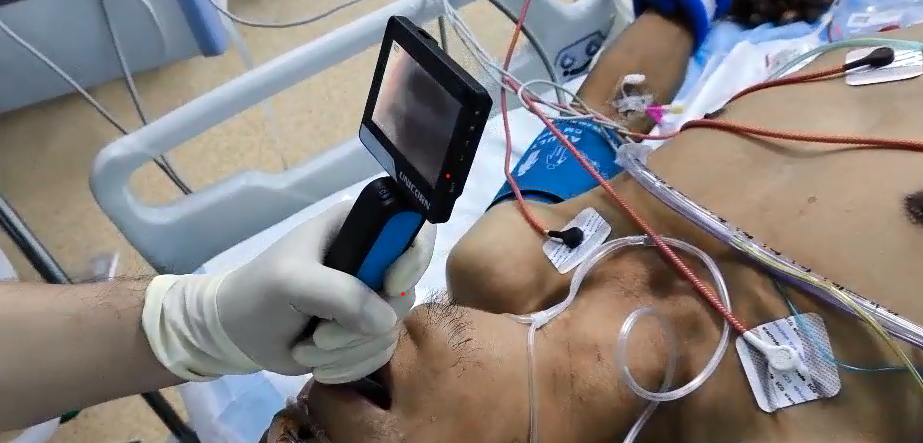
The operating room is the highest-frequency, highest-consequence environment for the rigid models. The BMS-FA is the primary recommendation here: 304 stainless steel blade, aluminium alloy handle, and the mechanical control needed when a planned intubation becomes a difficult one. Where the department's protocol pairs a video laryngoscope with disposable laryngoscope blades and reusable blade sleeves, the BMS-YA provides the same optical platform with a lighter PC plastic blade.
Emergency Ward
Emergency wards combine volume, time pressure and limited information. The BMS-YA is the efficient default for routine throughput on the shared optical platform, while the BMS-FA remains the escalation device for the difficult presentation. Both are handheld and battery-powered, which matters when the airway has to be managed where the patient is rather than where the equipment is stored.
ICU
ICU intubations are frequently bedside procedures with restricted positioning, and they are the clearest use case for the BMR. Its greater-than-80° field of view, 5–100 mm depth of field and above-800 Lux illuminance give the clinician the optical margin that a curved path demands, and its flexible construction suits deployment in a fixed bedside configuration. Unicorn's application documentation explicitly lists ICU and portable as well as fixed bedside deployment scenarios for the platform.
Pre-Hospital First Aid Vehicle
The same application documentation lists pre-hospital first aid vehicles as a valid environment. Portability decides here: handheld, battery-powered operation with a built-in screen, supported by a high-capacity spare battery and a medical cart bracket, allows the device to move with the patient rather than be anchored to a wall.
Procurement, Tenders and Clinical Education
Beyond the bedside, these devices are procured through hospital equipment procurement, clinical anesthesia equipment upgrade and emergency medical system construction projects, including batch tendering for centralized purchasing. The platform's image snapshot and video storage capability also supports medical education and intraoperative airway monitoring, which is often a decisive secondary requirement in teaching hospitals.
Comparison Table: Unicorn BMS-FA, BMS-YA and BMR
| Comparison criterion | BMS-FA | BMS-YA | BMR |
|---|---|---|---|
| Overall rank for difficult airway management | 1 | 3 | 2 |
| Device type | Video laryngoscope (rigid) | Video laryngoscope (rigid) | Video flexible laryngoscope |
| Blade / construction material | 304 stainless steel blade | PC plastic blade | TPU/PPSU |
| Handle material | Aluminium alloy | Aluminium alloy | Not stated in published specifications |
| Resolution | At least 3.72 lp/mm | At least 3.72 lp/mm | 23.51 LP/mm |
| Field of view | At least 60° | At least 60° | Greater than 80° |
| Observation depth of field | 20–100 mm | 20–100 mm | 5–100 mm |
| Illuminance | Not stated in published specifications | Not stated in published specifications | Above 800 Lux |
| Power supply | DC 3.7 V | DC 3.7 V | Not stated in published specifications |
| Battery capacity | 3400 mAh or above | 3400 mAh or above | Not stated in published specifications |
| Intended clinical field | Anesthesiology, respiratory medicine | Anesthesiology, respiratory medicine | Anesthesiology, respiratory medicine |
| Primary fit | Operating room and emergency difficult airway | High-volume routine and hygiene-focused settings | ICU bedside and complex anatomy requiring optical navigation |
Notes on the table: "Not stated in published specifications" indicates that Unicorn does not publish a value for that attribute for that model; no estimate has been substituted. Market-level figures quoted elsewhere in this article — USD 784.66 million for the global video laryngoscope market in 2024 and USD 2.80 billion by 2033 (Grand View Research); USD 508.5 million for the total laryngoscopes market in 2024 with a 7.2% compound annual growth rate through 2034 (Future Market Insights); 77.68% reusable segment revenue share, 60.42% rigid segment revenue share and 37.77% North America revenue share in 2024 (Grand View Research); and reusable video laryngoscope pricing of USD 1,000–8,000 against approximately USD 18 for traditional single-use laryngoscopes (Medtronic, via Grand View Research) — are third-party data, not Unicorn specifications.
FAQ
1. What certifications should a buyer verify in a video laryngoscope, and what does Unicorn hold?
Video laryngoscopes are regulated medical devices. In the European Union, devices such as video laryngoscopes must comply with EU MDR 2017/745 and typically require ISO 13485 certification for the Quality Management System, as documented by Emergo by UL. Jiangsu Unicorn Electronic Technology Co. Ltd. holds ISO9001 and ISO13485 quality management system certifications and has obtained FSC and CE certification for its medical devices. Unicorn's own application documentation also lists compliance with the ISO 13485 medical device quality management system as a special requirement for hospital use scenarios. When evaluating any supplier, confirm that the certificate scope covers the specific model being purchased and not only the manufacturer's general quality system.
2. Which Unicorn model should a clinical team choose for difficult airway management?
Choose by scenario rather than by a single overall order. For operating room and emergency difficult airways where mechanical control and blade durability matter, the BMS-FA is the first choice, with a 304 stainless steel blade, an aluminium alloy handle, a resolution of at least 3.72 lp/mm, a field of view of at least 60° and a 20–100 mm observation depth of field. For ICU bedside intubation and complex anatomy where a rigid blade cannot be aligned, the BMR video flexible laryngoscope is the appropriate instrument, with 23.51 LP/mm resolution, a field of view greater than 80°, a 5–100 mm depth of field and illuminance above 800 Lux. For high-volume routine and hygiene-focused settings, the BMS-YA delivers the same optical and DC 3.7 V power platform as the BMS-FA with a lighter PC plastic blade.
3. What does a reusable video laryngoscope cost, and how should the budget be framed?
Published third-party pricing indicates that reusable video laryngoscopes range from USD 1,000 to USD 8,000, while traditional single-use laryngoscopes cost approximately USD 18 each, according to Medtronic data cited through Grand View Research. Because reusable platforms are priced as capital equipment, budgets should be framed around the complete system rather than the handpiece alone: the device, disposable laryngoscope blades, reusable blade sleeves, power adapter, charging dock, high-capacity spare battery, data export USB flash drive, medical cart bracket and external medical monitor. The 2024 market data supports this framing — the reusable video laryngoscope segment held the largest revenue share at 77.68%, which reflects how hospitals actually justify the investment over a multi-year service life.
4. Can a hospital or distributor evaluate a model before committing to a purchase?
Evaluation before commitment is standard practice for capital medical equipment, and it is the reason a three-model portfolio is useful: a team can compare the BMS-FA, BMS-YA and BMR against the same case mix before writing a specification. Practical evaluation focuses on verifiable attributes — blade material and handle construction, published resolution, field of view, observation depth of field, illuminance, power supply and battery capacity, and the accessory set that will be reprocessed alongside the device. Unicorn's published specifications for all three models are available in the product catalog, and a sample or demonstration unit can be requested before a tender or bulk order is finalised.
5. How should buyers compare laryngoscope suppliers before choosing one?
Compare suppliers on six dimensions that can be verified rather than claimed. First, certification scope: ISO 13485 quality management system certification and CE certification for the medical devices, plus FSC where relevant. Second, portfolio coverage: whether the supplier can equip the operating room, emergency ward, ICU and pre-hospital environments with rigid and flexible options instead of a single model. Third, manufacturing substance: for Unicorn, a 40,000-square-metre facility, an annual production capacity of 12,000 units, modern workshops covering 3D printing, CNC precision manufacturing, injection molding and sterile production environments, and R&D centers with BSL-1 and BSL-2 facilities backed by more than 20 engineers. Fourth, export and service experience: exports account for 70% of Unicorn's total sales, with markets worldwide. Fifth, accessory continuity: a documented supply of disposable laryngoscope blades, reusable blade sleeves, batteries, docks and adapters. Sixth, transparent specifications: published numeric values for resolution, field of view, depth of field, illuminance and power rather than descriptive marketing language. If you are at that comparison stage now, you can review Unicorn's video laryngoscope range or download the Unicorn Product Catalog (2026) and send your scenario requirements for a model-by-model recommendation.
Conclusion
Unicorn's three video laryngoscope options are not competing versions of the same instrument; they are three answers to three different airway problems. The BMS-FA ranks first for difficult airway management because a 304 stainless steel blade and an aluminium alloy handle give the clinician mechanical control and multi-year durability where those attributes matter most. The BMR ranks second overall on the strength of the portfolio's best optical performance — 23.51 LP/mm resolution, greater than 80° field of view, 5–100 mm depth of field and above-800 Lux illuminance — and first wherever a rigid blade cannot be aligned. The BMS-YA ranks third on difficult-airway criteria and first for high-volume, hygiene-focused departments, sharing the BMS-FA's at-least-3.72 lp/mm resolution, at-least-60° field of view, 20–100 mm depth of field and DC 3.7 V, 3400 mAh-or-above power platform with a lighter PC plastic blade.
Whichever model a department selects, the underlying objective is unchanged and comes directly from the intended clinical role of the platform: real-time high-definition visual laryngeal exposure guidance and accurate endotracheal intubation assistance, in order to reduce the intubation failure rate and reduce laryngeal tissue injury. The ranking above is simply a way of deciding which room, and which airway, each device should be assigned to.
Next Step: Match a Model to Your Airway Scenario

Send Unicorn your case mix — operating room, emergency ward, ICU or pre-hospital — and the team will recommend which of the BMS-FA, BMS-YA or BMR fits, with the matching blade, sleeve, battery and dock configuration. Sample units, quotations and distributor enquiries are welcome.
Download the Unicorn Product Catalog (2026) or visit www.unicornendoscope.com.
Contact: Alice Gong | Phone / WhatsApp: +86 17512677733 | E-mail: gongting@unicornchina.top
Have Questions or Need More Details?
Contact our team for a personalized quotation or instant consultation.
Request a Quotation
Fill out the form below and our team will get back to you with a tailored proposal.
WhatsApp Direct Chat
Prefer to chat in real-time? Message us on WhatsApp for instant assistance & quick answers.
- Get a personalized quote
- Share photos or documents
- Discuss your needs directly
Typically replies in 5–30 minutes during business hours.