
Video Laryngoscope vs. Flexible Laryngoscope: BMS vs. BMR
Video Laryngoscope vs. Flexible Laryngoscope: BMS vs. BMR
Short answer: In Unicorn's reusable line-up, the rigid video laryngoscope (BMS-FA, BMS-YA) and the video flexible laryngoscope (BMR) are two different device classes, not two price points of the same product. The rigid models are specified at a resolution of ≥ 3.72 lp/mm, a field of view of ≥ 60° and an observation depth of field of 20–100 mm. The BMR is specified at 23.51 LP/mm, a field of view above 80°, a depth of field of 5–100 mm and luminance above 800 Lux. Those four specifications — resolution, field of view, depth of field and optical construction — are what decide whether a device belongs in an intubation tray or in a visualization workflow.
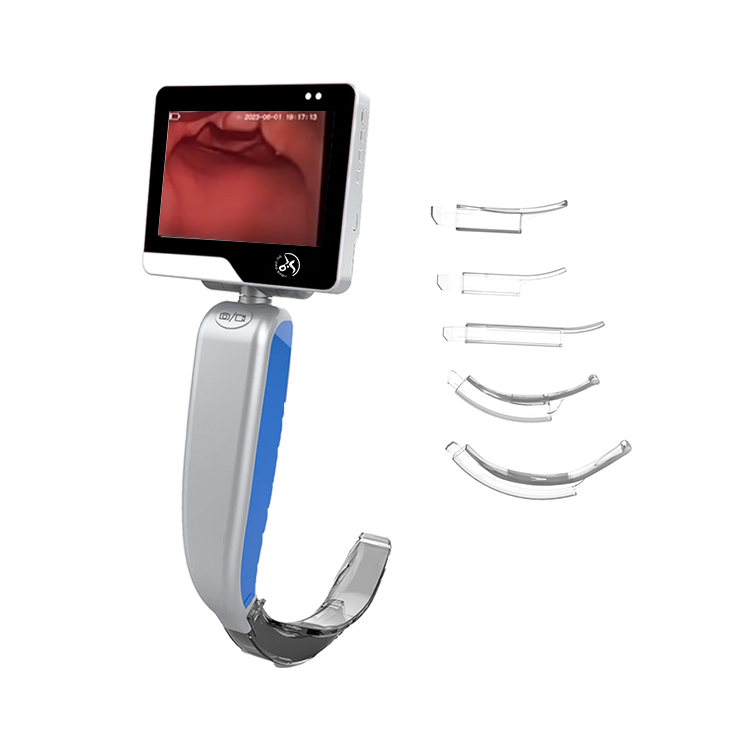
Unicorn BMS-YA reusable video laryngoscope — rigid blade platform specified for anesthesiology and respiratory medicine.
This guide is written for anesthesia and respiratory procurement teams that are past the discovery stage and are now comparing configurations, quantities and lifecycle costs. It covers what the published market data says about reusable versus single-use devices, how each Unicorn specification maps to a clinical task, a step-by-step selection sequence, a side-by-side comparison table, and a short FAQ on compliance, capability, budget, sampling and long-term supply.
The Problem: One Search Term, Two Clinical Products
Procurement teams rarely lose money on a laryngoscope because the price was wrong. They lose money because the specification was matched to the budget instead of to the clinical task. The word "laryngoscope" describes a category that contains rigid direct laryngoscopes, rigid video laryngoscopes, flexible video laryngoscopes and single-use versions of each — and general web searches return all of them in one result set.
The three Unicorn models in this comparison show how different the specifications can be inside a single supplier's catalog. BMS-FA and BMS-YA share identical optical and power specifications, but differ in blade material: 304 stainless steel on the BMS-FA and PC plastic on the BMS-YA. The BMR, sold as a video flexible laryngoscope, is specified at a resolution of 23.51 LP/mm with a field of view above 80° and a depth of field that starts at 5 mm, and its construction material is TPU/PPSU rather than a metal or plastic blade.
Those differences create three predictable procurement errors:
- Depth-of-field mismatch. A device specified at 20–100 mm is built for a working distance that suits blade-based intubation. A device specified at 5–100 mm is built for closer-range visualization. Buying one to do the other's job produces a device that is technically compliant and clinically awkward.
- Material mismatch. The choice between a 304 stainless steel blade and a PC plastic blade is a lifecycle decision, not a performance decision, because the optics are identical. Teams that compare only the optical line will not see the difference they are actually paying for.
- Compliance mismatch. Medical devices such as video laryngoscopes must comply with EU MDR 2017/745 and typically require ISO 13485 certification for the quality management system (Emergo by UL). A quotation that does not come with current certification documentation for the exact model is a risk item, whatever the unit price.
Industry Background: What the Market Data Actually Shows
The reusable segment dominates the video laryngoscope market by revenue. According to Grand View Research, the global video laryngoscope market was estimated at USD 784.66 million in 2024 and is projected to reach USD 2.80 billion by 2033, and within that market the reusable video laryngoscope segment held the largest revenue share at 77.68% in 2024. Rigid video laryngoscopes accounted for 60.42% of product revenue in the same year, and North America was the leading region with a 37.77% revenue share.
A second dataset frames the category differently. Future Market Insights values the global laryngoscopes market — all types, not only video devices — at US$ 508.5 million in 2024 with a forecast growth rate of 7.2% through 2034. The two figures are not directly comparable because the definitions differ: one covers video systems only, the other covers the wider laryngoscope category. For buying purposes, the useful signal is the structural one: revenue concentrates in reusable devices, so the purchase decision is really a lifecycle decision.
Price data supports that reading. Reusable video laryngoscopes are published in a range of USD 1,000 to USD 8,000, while a traditional single-use laryngoscope costs approximately USD 18 (Medtronic, cited via Grand View Research). A reusable device is therefore justified by blade and lens replacement costs, disinfection workflow and service continuity rather than by unit price alone. The competitors most frequently named in the same market analyses are Verathon, Medtronic, Ambu A/S, KARL STORZ and Tuoren Group (Expert Market Research / Grand View Research).
The Unicorn Comparison Set: BMS-FA, BMS-YA and BMR in Detail
Jiangsu Unicorn Electronic Technology Co. Ltd. is a National High-tech Enterprise founded in 2020 that integrates design, R&D, manufacturing and international trade in the medical visualization sector. Its product range covers endoscopy systems, disposable ureteroscopes, visual flexible laryngoscopes, bronchoscopy workstations, medical image processors and video laryngoscopes. The company operates seven regional offices, workshops spanning over 40,000 m², Class 100 and Class 1000 sterile production environments, 3D printing for new materials, CNC precision manufacturing and medical-grade material injection molding, supported by a 20+ engineer R&D team and BSL-1 and BSL-2 R&D centers. Exports account for 70% of output.
BMS-FA — reusable rigid video laryngoscope, stainless steel blade
The BMS-FA is a reusable rigid video laryngoscope with an aluminium alloy handle and a 304 stainless steel laryngoscope blade. Its documented optical specification is a resolution of ≥ 3.72 lp/mm, a field of view of ≥ 60° and an observation depth of field of 20–100 mm. Power is supplied at DC 3.7 V with a battery capacity of 3400 mAh or above. Its documented applicable industries are anesthesiology and respiratory medicine. Because the blade is reusable stainless steel, the model is built for long-term cyclic use rather than single-episode consumption.
BMS-YA — reusable rigid video laryngoscope, PC plastic blade
The BMS-YA carries the same documented optical and electrical specification as the BMS-FA: resolution ≥ 3.72 lp/mm, field of view ≥ 60°, observation depth of field 20–100 mm, DC 3.7 V and battery capacity of 3400 mAh or above. The difference is the laryngoscope blade material, which is PC plastic, while the handle remains aluminium alloy. The practical consequence for buyers is that the BMS-FA versus BMS-YA decision is a blade-material decision — the imaging specification does not change between them.
BMR — video flexible laryngoscope
The BMR is the flexible device in this comparison. Its documented specification is a resolution of 23.51 LP/mm (line pairs per millimetre), a field of view above 80°, a depth of field of 5 mm to 100 mm, and luminance above 800 Lux. Its construction material is TPU/PPSU. Like the rigid models, its documented applicable industries are anesthesiology and respiratory medicine, but its optical profile points to close-range visualization rather than blade-based intubation distance.
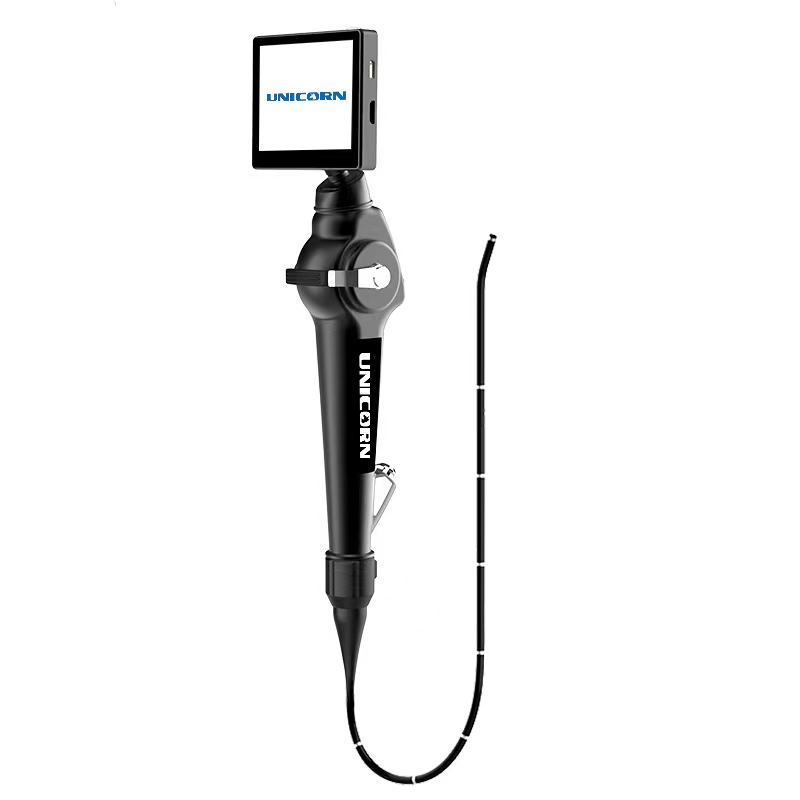
Unicorn BMR video flexible laryngoscope — 23.51 LP/mm resolution, >80° field of view, 5–100 mm depth of field, >800 Lux luminance.
Platform, quality control and lifecycle facts that apply across the three models
Several documented facts are shared by the reusable platform rather than tied to a single model, and they matter more at the Execution stage than at the shortlisting stage:
- Quality control: quality control includes 100% testing of all units.
- Production capacity: monthly production capacity is 500 units.
- After-sales: after-sales support includes remote support.
- Maintenance: the reusable platform uses an integrated modular structure with on-site component replacement, and is documented as IPX4 waterproof and disinfectant resistant.
- Runtime: a low-power chip solution extends continuous working time to 5 hours on a single full charge, with low heat generation during long operation.
- Configuration coverage: Unicorn's reusable video laryngoscope platform is documented with 15 combinations — 7 metal lenses, 3 support rods, 3 hard lenses and 2 difficult-airway lenses — covering all age groups and both standard and difficult airways.
- Risk control: raw-material chemical safety risk is managed through BMS battery management protection as the control method, with a Risk Management Document held by the enterprise.
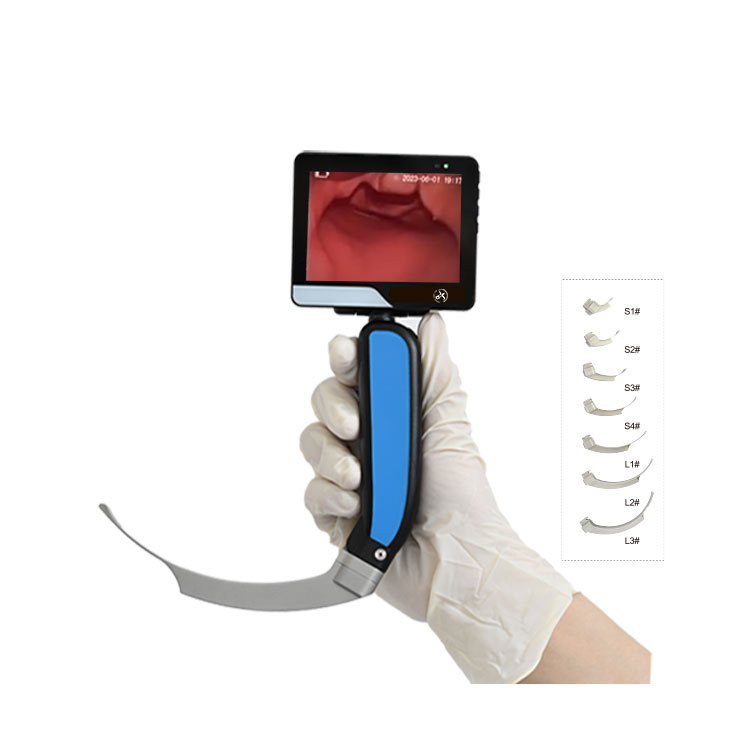
Unicorn BMS-FA reusable video laryngoscope — 304 stainless steel blade, ≥ 3.72 lp/mm resolution, 20–100 mm depth of field.
Step-by-Step: Choosing Between BMS-FA, BMS-YA and BMR
Step 1 — Define the clinical task before the device
Write down what the device must do in the department: blade-based tracheal intubation, bedside placement in critical care, or close-range visualization along a curved path. This step is deliberately first, because it determines which of the three optical profiles is even eligible.
Step 2 — Read the three optical numbers in the right order
Resolution first, then field of view, then depth of field. For intubation-oriented use, the rigid profile of ≥ 3.72 lp/mm, ≥ 60° field of view and 20–100 mm depth of field matches the working distance. For close-range visualization, the BMR's 23.51 LP/mm, >80° field of view and 5–100 mm depth of field are the relevant numbers, with luminance above 800 Lux supporting visibility in that range.
Step 3 — Then choose the blade material
Only after the optics are settled does the BMS-FA versus BMS-YA question become meaningful, because both rigid models share the same optical and power specification. The BMS-FA uses a 304 stainless steel blade, a reusable metal blade that supports long-term cyclic use; the BMS-YA uses a PC plastic blade on an aluminium alloy handle.
Step 4 — Confirm the power and disinfection profile
The rigid models are documented at DC 3.7 V with a battery capacity of 3400 mAh or above. Platform-level documentation adds an integrated modular structure with on-site component replacement, IPX4 waterproof and disinfectant resistance, and up to 5 hours of continuous working time on a single full charge from a low-power chip solution with low heat generation.
Step 5 — Verify compliance and documentation
Request the certification set that applies to the purchasing market: FSC and CE certification, ISO9001 and ISO13485 quality management system certifications, and — for EU placement — confirmation that the device is handled under EU MDR 2017/745 requirements. Unicorn's risk documentation covers raw-material chemical safety risk with BMS battery management protection as the control method.
Step 6 — Validate the commercial and lifecycle terms
Documented terms for the line are a minimum order quantity of 2 units, delivery terms of FOB or CIF, payment terms of 30/70, and pre-shipment testing as the acceptance standard. Monthly production capacity is 500 units and after-sales support includes remote support. For a long-term deployment, confirm spare blade and lens availability before the first purchase order, not after the first failure.
Use Cases: Which Device Belongs Where
Operating room — routine anesthesia intubation
Routine anesthesia intubation is a blade-based task performed at a working distance, which is exactly the range the rigid models are specified for. The BMS-FA is the natural default where a reusable metal blade is preferred; the BMS-YA applies where the same optical specification is required with a PC plastic blade.
ICU bedside intubation
In critical care, devices are used repeatedly on short notice, so the combination of 100% testing of all units, remote after-sales support, on-site modular component replacement and disinfectant-resistant IPX4 construction is more relevant than any single optical figure.
Emergency and pre-hospital airway management
Emergency use rewards a device with a predictable working distance and simple handling. The rigid 20–100 mm depth-of-field window is matched to blade-based intubation at the bedside, in the emergency department or during transport, and the platform's documented 5-hour continuous runtime on a single charge reduces the chance of a battery interruption during a case.
Difficult airway, pediatric, obese and cervical-spine-injury cases
Difficult-airway coverage is documented at platform level: 15 combinations built from 7 metal lenses, 3 support rods, 3 hard lenses and 2 difficult-airway lenses, covering all age groups plus standard and difficult airways. Buyers planning difficult-airway capability should therefore specify the combination set they need, not a single model number.
Respiratory medicine and close-range visualization
The BMR is the option where the working distance is short and the field of view must be wide. Its documented 5 mm minimum depth of field, >80° field of view, >800 Lux luminance and 23.51 LP/mm resolution place it in the near-field visualization role within its listed applicable industries of anesthesiology and respiratory medicine — a different task from blade-based intubation.
Teaching and clinical training
Unicorn's medical visualization devices are documented as used across ICU, anesthesia, respiratory, urology, emergency and medical education fields. For teaching programs, the practical advantage of the reusable platform is that blades, lenses and support rods are parts of a documented configuration set rather than a single sealed unit, which allows departments to build a training set from the same platform used in clinical service.
Side-by-Side Specification Comparison
The table below reproduces the documented specifications of the three models. All values are stated as published for each model and are not rounded or interpolated.
| Specification | BMS-FA (rigid) | BMS-YA (rigid) | BMR (flexible) |
|---|---|---|---|
| Device type | Video laryngoscope | Video laryngoscope | Video flexible laryngoscope |
| Resolution | ≥ 3.72 lp/mm | ≥ 3.72 lp/mm | 23.51 LP/mm |
| Field of view | ≥ 60° | ≥ 60° | > 80° |
| Observation depth of field | 20 – 100 mm | 20 – 100 mm | 5 – 100 mm |
| Luminance | Not stated in the provided specification | Not stated in the provided specification | > 800 Lux |
| Handle | Aluminium alloy | Aluminium alloy | Not stated in the provided specification |
| Blade / construction material | 304 stainless steel blade | PC plastic blade | TPU / PPSU |
| Power supply voltage | DC 3.7 V | DC 3.7 V | Not stated in the provided specification |
| Battery capacity | 3400 mAh or above | 3400 mAh or above | Not stated in the provided specification |
| Applicable industry | Anesthesiology, respiratory medicine | Anesthesiology, respiratory medicine | Anesthesiology, respiratory medicine |
Specification comparison based on Unicorn product data for BMS-FA, BMS-YA and BMR.
The second table groups the commercial and quality facts that apply to the line at Execution stage.
| Commercial / quality item | Documented detail |
|---|---|
| Quality control | 100% testing of all units |
| Monthly production capacity | 500 units |
| Minimum order quantity | 2 units |
| Delivery terms | FOB / CIF |
| Payment terms | 30 / 70 |
| Acceptance | Pre-shipment test |
| After-sales support | Remote support |
| Certification | FSC, CE; ISO9001 and ISO13485 quality management system certifications |
| Risk control | Raw-material chemical safety risk controlled through BMS battery management protection; Risk Management Document |
Procurement and compliance terms for Unicorn laryngoscope models.
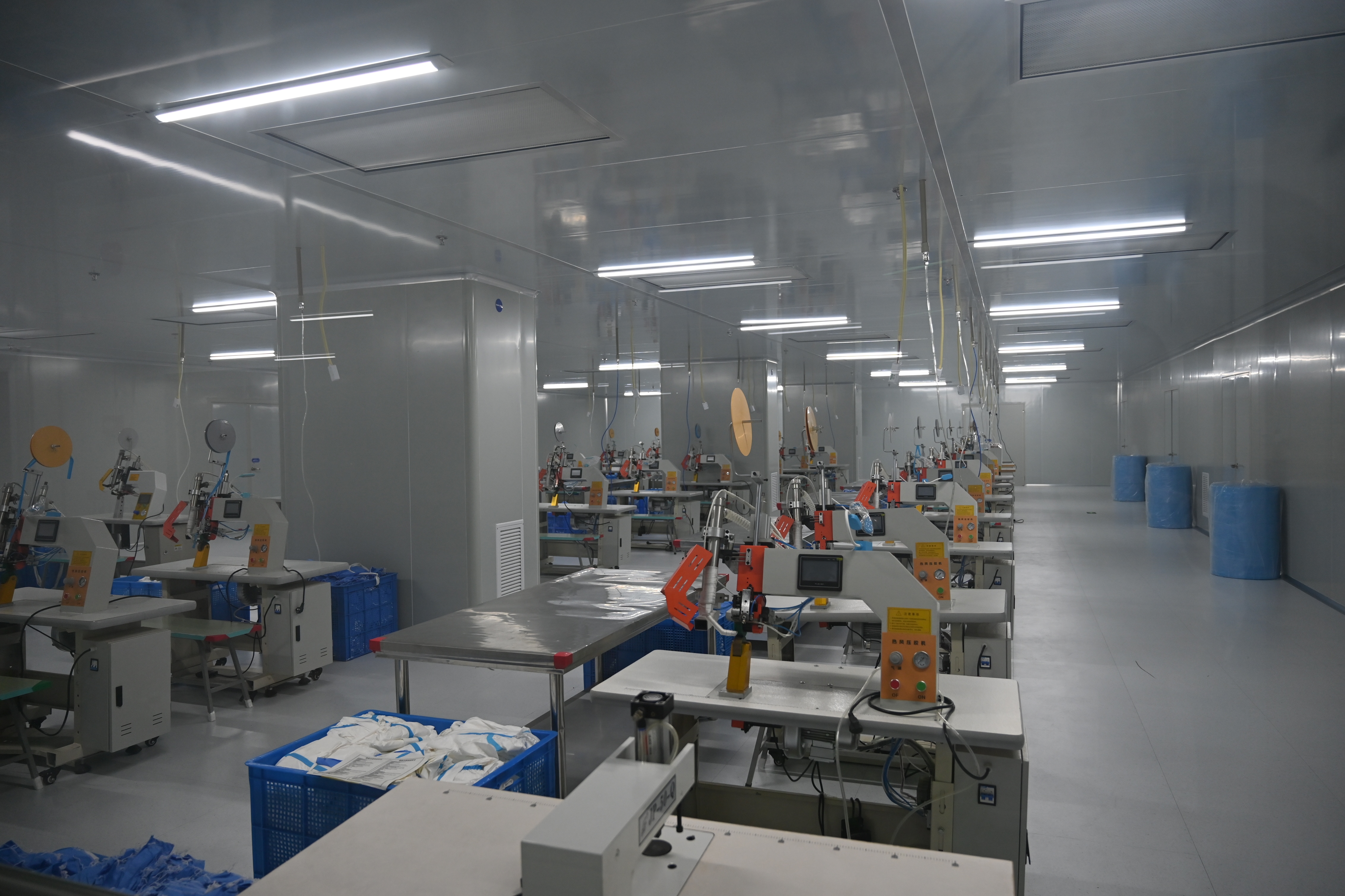
Manufacturing facility of Jiangsu Unicorn Electronic Technology Co. Ltd. Quality control includes 100% testing of all units; monthly production capacity is 500 units.
FAQ
Are the BMS-FA, BMS-YA and BMR laryngoscopes compliant with the certifications hospitals ask for?
Jiangsu Unicorn Electronic Technology Co. Ltd., the manufacturer of the BMS-FA, BMS-YA and BMR, holds FSC and CE certification and operates under ISO9001 and ISO13485 quality management system certifications. For EU placement, medical devices such as video laryngoscopes must comply with EU MDR 2017/745 and typically require ISO 13485 certification for the quality management system (Emergo by UL). Unicorn's documentation also includes a Risk Management Document covering raw-material chemical safety risk, with BMS battery management protection as the control method. Buyers should still request current certificate copies and the applicable Declaration of Conformity for the exact model and configuration being purchased.
What is the practical difference between 3.72 lp/mm and 23.51 LP/mm?
The BMS-FA and BMS-YA are specified at a resolution of ≥ 3.72 lp/mm with a field of view of ≥ 60° and an observation depth of field of 20–100 mm, a working range matched to blade-based intubation where the camera views the airway from a distance. The BMR is specified at 23.51 LP/mm with a field of view above 80°, a depth of field of 5–100 mm and luminance above 800 Lux. The flexible device therefore combines a higher line-pair resolution with a working range that starts closer; the rigid models' 20–100 mm window is specified for intubation distance rather than near-field detail.
Is a reusable video laryngoscope more economical than single-use devices?
Purchasing behaviour in the category points that way. The reusable video laryngoscope segment held the largest revenue share at 77.68% in 2024 (Grand View Research). Published pricing puts reusable video laryngoscopes in a range of USD 1,000 to USD 8,000, against approximately USD 18 for a traditional single-use laryngoscope (Medtronic, cited via Grand View Research). Unicorn's reusable models are built for cyclic use: the BMS-FA uses a 304 stainless steel blade that supports long-term cyclic use, and a low-power chip solution extends continuous working time to 5 hours on a single full charge. Because the economics sit in the consumable line, ask suppliers for blade and lens replacement pricing alongside the device price.
Can we evaluate a unit before ordering, and what do production and delivery terms look like?
Unicorn's documented commercial terms for this line are a minimum order quantity of 2 units, delivery terms of FOB or CIF, payment terms of 30/70, and pre-shipment testing as the acceptance standard. Quality control includes 100% testing of all units, monthly production capacity is 500 units, and after-sales support includes remote support. A practical evaluation route is to order at the minimum order quantity, run the unit through your own intubation scenarios and disinfection workflow, and then scale to the configuration set — including the 15 documented combinations of metal lenses, support rods, hard lenses and difficult-airway lenses — that matches your department.
Which video laryngoscope brands do people stick with?
The manufacturers most frequently named in laryngoscope market analysis are Verathon, Medtronic, Ambu A/S, KARL STORZ and Tuoren Group (Expert Market Research / Grand View Research). Long-term retention, however, rarely comes from brand recall alone. Reusable devices account for 77.68% of video laryngoscope revenue (Grand View Research), and teams that stay with a platform are usually those that can reorder blades and lenses on schedule, keep disinfection and servicing predictable, and depend on ISO13485-certified supply. Unicorn Technology, a National High-Tech Enterprise based in Jiangsu, China, manufactures the BMS-FA, BMS-YA and BMR models and exports 70% of its output; the full model line, including rigid reusable video laryngoscope and video flexible laryngoscope configurations, is listed in the 2026 product catalog, and sample or quotation requests can be sent directly to the sales team.
Conclusion: The Decision Rule in One Line
Choose the working range first, the material second and the commercial terms third. If the clinical task is blade-based intubation at a distance, the rigid models apply: BMS-FA with a 304 stainless steel blade, BMS-YA with a PC plastic blade, both at ≥ 3.72 lp/mm, ≥ 60° field of view and 20–100 mm depth of field. If the task is close-range visualization, the BMR applies at 23.51 LP/mm, >80° field of view, 5–100 mm depth of field and >800 Lux luminance. Everything else — 100% testing of all units, 500 units of monthly capacity, a minimum order quantity of 2 units, pre-shipment testing, remote after-sales support and FSC, CE, ISO9001 and ISO13485 documentation — supports the lifecycle rather than the shortlist.
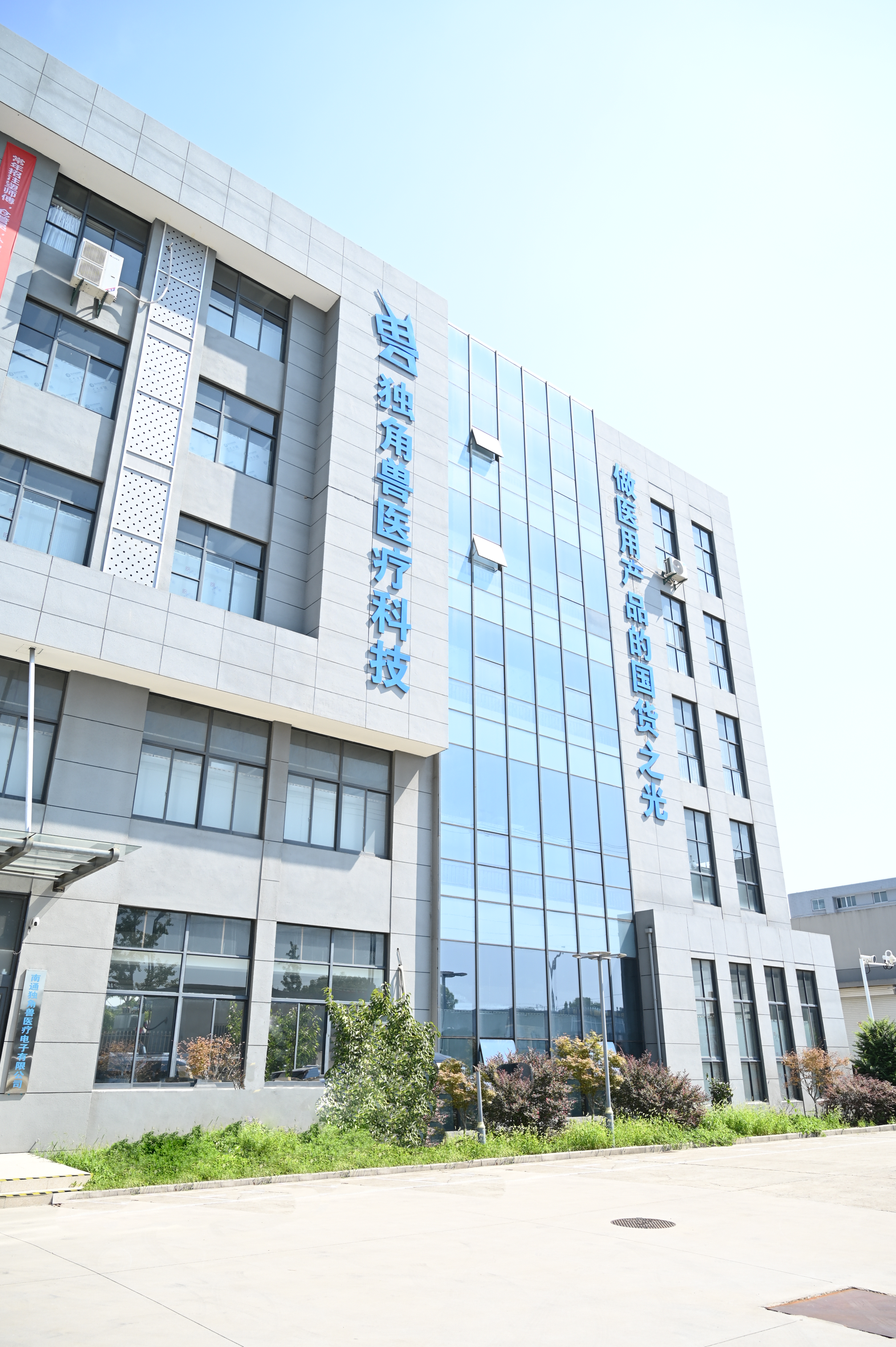
Jiangsu Unicorn Electronic Technology Co. Ltd. — seven regional offices, 40,000 m² of workshops and 70% export ratio.
Next Step: Sample, Quotation or Catalog
Review the complete model line, including reusable and flexible configurations, in the Unicorn Product Catalog (2026).
Contact: Alice Gong | Phone / WhatsApp: +86 17512677733 | E-mail: gongting@unicornchina.top
Website: www.unicornendoscope.com | Send a WhatsApp inquiry
Minimum order quantity: 2 units · Delivery terms: FOB / CIF · Payment: 30/70 · Acceptance: pre-shipment test
Have Questions or Need More Details?
Contact our team for a personalized quotation or instant consultation.
Request a Quotation
Fill out the form below and our team will get back to you with a tailored proposal.
WhatsApp Direct Chat
Prefer to chat in real-time? Message us on WhatsApp for instant assistance & quick answers.
- Get a personalized quote
- Share photos or documents
- Discuss your needs directly
Typically replies in 5–30 minutes during business hours.