
BMS-FA vs. BMS-YA vs. BMR: Video Laryngoscope Comparison
Three Unicorn laryngoscope models are usually quoted side by side: BMS-FA and BMS-YA are rigid reusable video laryngoscopes, and BMR is a visual flexible video laryngoscope. All three sit under the same ISO 13485:2016 certificate (UKZB25MD30140R0S) and the same CE notification certificate (RPS/5400/2022), and all three are quoted on the same commercial terms: MOQ 2 units, FOB/CIF delivery, 30% deposit with 70% before shipment, and pre-shipment testing as the acceptance criterion. The purchase decision therefore turns on three model-level questions, not on brand: what the optical train is documented to deliver, what the blade or insertion section is made of, and what must be confirmed on the datasheet before a purchase order is released.
This guide is written for buyers in the evaluation and execution stages — hospital procurement teams, distributors and OEM brand owners who already know they need a video laryngoscope and now have to choose between three formats from one manufacturer. It separates what is documented from what has to be verified, and it treats the purchasing terms as part of the technical decision rather than an afterthought.
Problem Definition: Why Model-Level Ambiguity Costs Buyers Money
Laryngoscope sourcing errors at the evaluation stage are rarely brand errors. They are model errors, and they usually come from four specific sources.
1. Mixed optical units. Records in this category quote resolution in line-pairs per millimetre (lp/mm or LP/mm), in camera pixels, or not at all. BMS-FA is documented at ≥3.72 lp/mm with a 1600×1200 camera and a 3.0-inch LCD, while BMR is documented at 23.51 LP/mm. Those numbers describe different measurement approaches and cannot be ranked against each other without a common test method. A buyer who ranks them by magnitude alone can select the wrong device.
2. Format confusion. A rigid reusable video laryngoscope and a flexible video laryngoscope do not substitute for one another in clinical workflow. The blade format determines how the device is held, how the airway is approached and how the device is reprocessed. Choosing a rigid model for a task that needs a flexible insertion section is a planning failure, not a product failure.
3. Certificate coverage at company level instead of model level. A supplier can hold a valid quality-system certificate while the specific model on the quotation has not been matched to that certificate's scope. This is why the certificate numbers and scope wording, not just the words 'CE certified laryngoscope', belong in the tender file.
4. Acceptance criteria agreed after the goods arrive. If the acceptance test is not written into the order, the buyer ends up negotiating image quality, packaging and documentation after shipment. Pre-shipment testing exists to move that conversation to before dispatch.
Industry Background: What the Category Now Requires
Video laryngoscopy is defined in indexed biomedical literature as a procedural technique used for airway management, in which a laryngoscope blade equipped with a camera is used. That definition matters commercially because it frames the product as an imaging device as well as an airway device — which is why optical specifications carry real purchasing weight.
The category is also a growth category. Grand View Research reports the global video laryngoscope market at approximately USD 784.7 million in 2024, projected to reach USD 2,798.1 million by 2033 at a CAGR of 14.9%. The same source reports that reusable devices accounted for 65.8% of the usability segment in 2024, which is consistent with the way most hospitals still buy: a reusable capital device plus consumable or disposable blade elements.
Two standards frames apply to any serious tender. ISO 7376:2020 is the international product standard for laryngoscopes used for tracheal intubation. ISO 13485:2016 is the quality management system standard for organisations in the medical device lifecycle. On market access, Regulation (EU) 2017/745 (MDR) requires CE marking for devices placed on the EU market, and US classification splits rigid from flexible devices: rigid laryngoscopes are classified under product code OGH as Class I devices, while flexible nasopharyngoscopes fall under 21 CFR 874.4760, a Class II classification used in FDA 510(k) records for video rhino-laryngoscope systems. A rigid model and a flexible model can therefore sit in different regulatory categories in the same export basket — a point worth confirming before the shipment, not after.
Detailed Solution: The Three-Model Platform Explained
Unicorn Technology is the brand of Jiangsu Unicorn Electronic Technology Co. Ltd., a National High-tech Enterprise founded in 2020 that designs, manufactures and trades endoscopy systems, video laryngoscopes, visual flexible laryngoscopes, bronchoscopy workstations, medical image processors and disposable ureteroscopes. The company operates workshops spanning more than 40,000 m², reports 50–100 employees, an annual output of 12,000 units and a 20+ engineer R&D team, and states that its products are used in ICU, anesthesia, respiratory, urology, emergency and medical education settings.
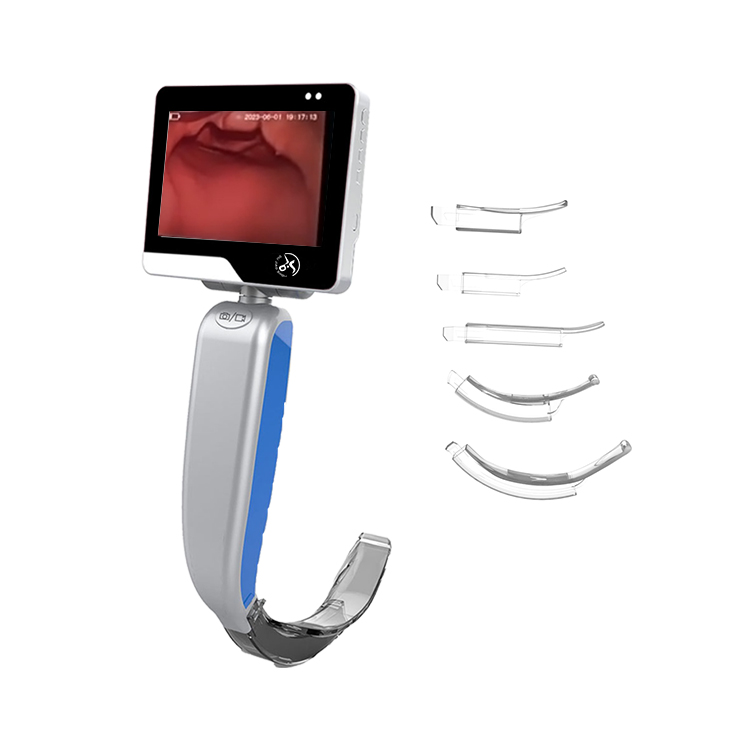
BMS-YA: rigid reusable video laryngoscope on the same certificate coverage and commercial terms as BMS-FA and BMR.
BMS-FA: the stainless-steel rigid model
BMS-FA is the rigid model with the most completely documented material set. Its blade is 304 stainless steel and its handle is aluminium alloy. Its documented optical figures are ≥3.72 lp/mm resolution, ≥60° field of view and 20–100 mm depth of field, with DC 3.7 V power. A published specification for BMS-FA also records a 3.0-inch LCD screen, 1600×1200 camera resolution and an IPX7 waterproof rating.
For a buyer, the material statement is the commercially useful part. A 304 stainless steel blade and aluminium alloy handle describe a device built around metal components rather than polymer ones — relevant to handling rigidity and to the reprocessing cycle a reusable device will go through in the department. The 20–100 mm depth of field places the useful focus range away from the lens, which is the working range a rigid blade geometry typically generates during intubation.
BMS-YA: the second rigid model, confirmed at certificate level
BMS-YA is a rigid video laryngoscope in the same programme. What is documented about it is compliance and commercial, not optical: it is listed against the ISO 13485:2016 certificate UKZB25MD30140R0S, listed against the CE notification certificate RPS/5400/2022, and covered by the same case record, terms and lead time as the other two models.
BMR: the flexible video laryngoscope
BMR is a visual flexible video laryngoscope, built with TPU and PPSU construction rather than metal. Its documented optical figures are 23.51 LP/mm resolution, >80° field of view, 5–100 mm depth of field, and >800 Lux illuminance.
The specification pattern tells the buyer what the device is for. The field of view is the widest of the three, the depth of field starts at 5 mm — close to the distal tip, which is the near-field range a flexible insertion section works in — and illuminance is stated in Lux, a light-output measure rather than a resolution measure. TPU/PPSU construction is a polymer approach suited to a flexible scope body. BMR should be evaluated as a flexible imaging device, not as a rigid intubation blade with a different label.
The shared base all three models inherit
Because the differences are model-level, it helps to state what does not change across the three:
- Quality system: ISO 13485:2016 certificate UKZB25MD30140R0S, issued by New Century Inspection & Certification Co., Ltd. (BCC) on 22 December 2025 and valid to 21 December 2028, covering design, production and sales of video anesthesia laryngoscope and anesthesia laryngoscope.
- CE notification certificate: RPS/5400/2022, with Medurion S.L. (EU authorised representative, Spain) recorded, issued 7 December 2022 and valid to 6 December 2027, with BMS-FA, BMS-YA and BMR all listed as related products.
- Production terms: OEM/ODM production with screen logo and power on/off logo customization, 500 units monthly capacity, 100% testing, export to all countries, and remote after-sales support.
- Commercial terms: MOQ 2 units, FOB/CIF delivery, 30% deposit and 70% before shipment, pre-shipment test as the acceptance criterion.
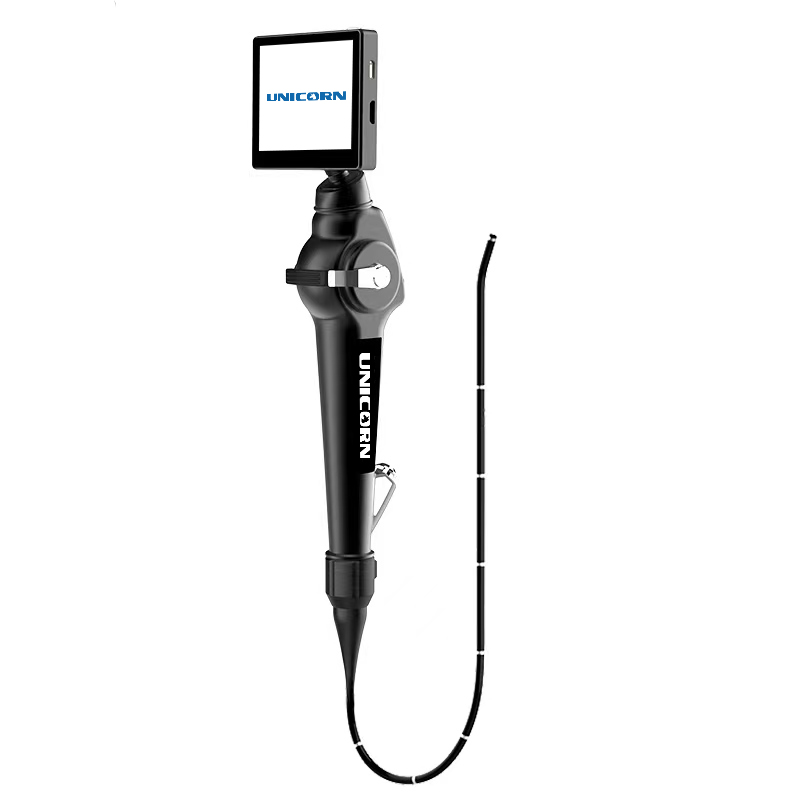
BMR: the flexible model, documented at 23.51 LP/mm, >80° field of view, 5–100 mm depth of field and >800 Lux illuminance.
Step-by-Step Breakdown: From Clinical Brief to Purchase Order
The following sequence is designed for buyers who are past the shortlist stage and need a defensible order file. It takes the three models in the order the decisions actually arrive.
- Fix the device format before the specifications. Decide whether the department needs a rigid reusable video laryngoscope (BMS-FA or BMS-YA) or a flexible video laryngoscope (BMR). This single decision removes two of the three models from the shortlist and prevents the most expensive type of error.
- Put optics in a common frame. Record resolution in the unit the supplier states it, note the field of view in degrees and the depth of field in millimetres, and never average the figures across models. Request the test method or a sample image set if the numbers must be compared formally.
- Confirm materials and reprocessing. BMS-FA is documented as 304 stainless steel blade with aluminium alloy handle. BMR is documented as TPU/PPSU construction. For BMS-YA, obtain the datasheet values before proceeding. Then match the material statement to your department's disinfection and sterilization workflow.
- Match the certificate to the model on the quotation. Ask for the ISO 13485:2016 certificate (UKZB25MD30140R0S) and the CE notification certificate (RPS/5400/2022) as PDFs, and check that the scope wording and the listed products cover the exact model you are buying for your destination market.
- Confirm the commercial terms in writing. MOQ 2 units, FOB or CIF delivery, 30% deposit and 70% before shipment. Note that the OEM/ODM capability record separately lists a 1-unit minimum order for production programmes — clarify which figure governs your specific configuration at quotation stage rather than assuming one applies.
- Write the acceptance test into the order. The acceptance criterion documented for these models is a pre-shipment test. Define what is inspected — imaging output, packaging, accessories, documentation set — and require the result before the balance payment is released.
- Plan around 30–45 days and 500 units per month. Typical production lead time is 30–45 days, with monthly capacity of 500 units. For rollouts across multiple sites, sequence the orders against that monthly ceiling instead of assuming a single batch.
Use Cases: Where Each Model Fits
The documented application field for these products is hospital clinical anesthesia, emergency intubation, difficult airway treatment and rescue operations, with medical institutions, device distributors and hospital groups recorded as users. Within that field, the three models divide along workflow rather than prestige.
Operating room and anesthesia department. Rigid reusable video laryngoscopes are the standard fit where the device is used repeatedly through a shift and reprocessed between cases. BMS-FA's metal blade and handle construction and its IPX7 rating are the properties that matter in that cycle.
ICU difficult airway. Where the airway plan has to be re-attempted or documented, real-time visualization and a recorded procedure are the operational requirements. A documented case record for these products reports complete operation video recording and multi-language UI as delivered features, alongside a portable battery design — relevant where the device moves between bedsides. BMS-FA's DC 3.7 V power and BMR's illuminance figure both serve that bedside use pattern.
Emergency and rescue. Portability and speed of setup dominate. A portable battery design and an integrated LCD screen reduce the number of components that must be located at the point of use. Emergency laryngoscope selection should be tested against the department's actual grab-bag configuration, not against a catalogue photo.
Respiratory and outpatient flexible evaluation. This is BMR territory. A flexible insertion section with a >80° field of view and a depth of field starting at 5 mm is built for near-field imaging through a curved path, which a rigid blade cannot follow.
Medical education. A documented case record includes manikin use, and recorded procedure video is the practical training asset: trainees can review the same airway view the operator saw.
One documented case, covering a five-year relationship with medical institutions, distributors and hospital groups on a 20-unit order for anesthesia, emergency intubation, difficult airway and rescue work, reports a high intubation success rate, minimal airway tissue injury and complete operation video recording as outcomes. It also records disposable blades as an available option — relevant to departments running a disposable laryngoscope policy alongside reusable capital equipment.
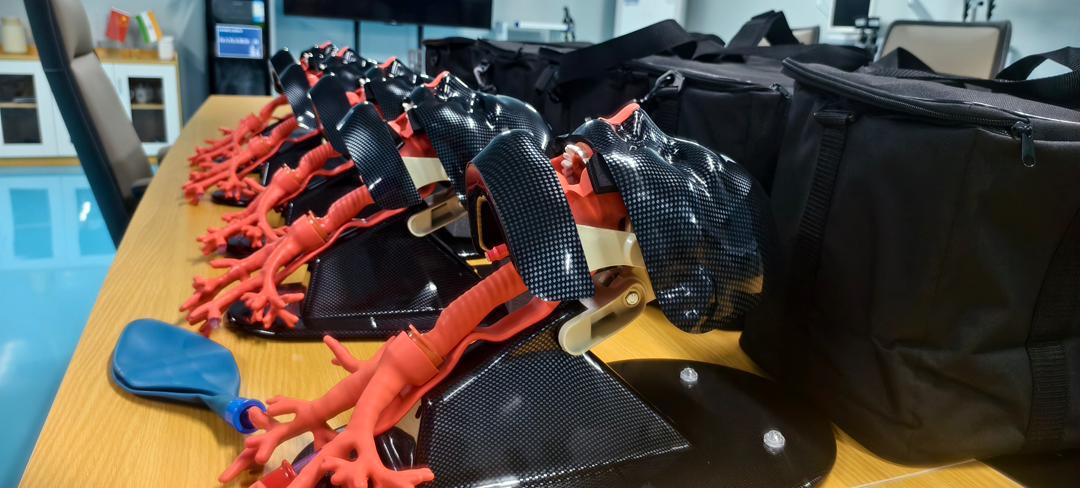
Recorded real-time visualization is the feature that carries through anesthesia, ICU and training use cases.
Comparison Table: Documented Specifications Side by Side
Table A — Materials and optical specifications
| Parameter | BMS-FA (rigid) | BMR (flexible) |
|---|---|---|
| Blade / insertion section material | 304 stainless steel | TPU / PPSU |
| Handle / body material | Aluminium alloy | TPU / PPSU construction |
| Resolution | ≥3.72 lp/mm | 23.51 LP/mm |
| Field of view | ≥60° | >80° |
| Depth of field | 20–100 mm | 5–100 mm |
| Power / illumination | DC 3.7 V | >800 Lux illuminance |
| Additional documented imaging data | 3.0-inch LCD, 1600×1200 camera resolution, IPX7 | — |
Table B — Shared commercial and compliance terms for BMS-FA, BMS-YA and BMR
| Attribute | Documented status (applies to all three models) |
|---|---|
| Model formats | BMS-FA rigid, BMS-YA rigid, BMR flexible video laryngoscope |
| ISO 13485:2016 | Certificate UKZB25MD30140R0S, issued by BCC, 22 Dec 2025 – 21 Dec 2028; scope: design, production and sales of video anesthesia laryngoscope and anesthesia laryngoscope |
| CE notification certificate | RPS/5400/2022, Medurion S.L. (EU authorised representative, Spain) recorded; issued 7 Dec 2022, valid to 6 Dec 2027; all three models listed |
| MOQ | 2 units (model purchasing terms); OEM/ODM capability record lists a 1-unit minimum for production programmes |
| Delivery terms | FOB / CIF |
| Payment terms | 30% deposit, 70% before shipment |
| Acceptance criteria | Pre-shipment test |
| Customization | OEM / ODM with screen logo and power on/off logo |
| Monthly capacity | 500 units |
| Typical lead time | 30–45 days |
| Quality control | 100% testing |
| After-sales | Remote support |
| Export markets | All countries |
| Documented clinical application | Hospital clinical anesthesia, emergency intubation, difficult airway treatment, rescue operations |
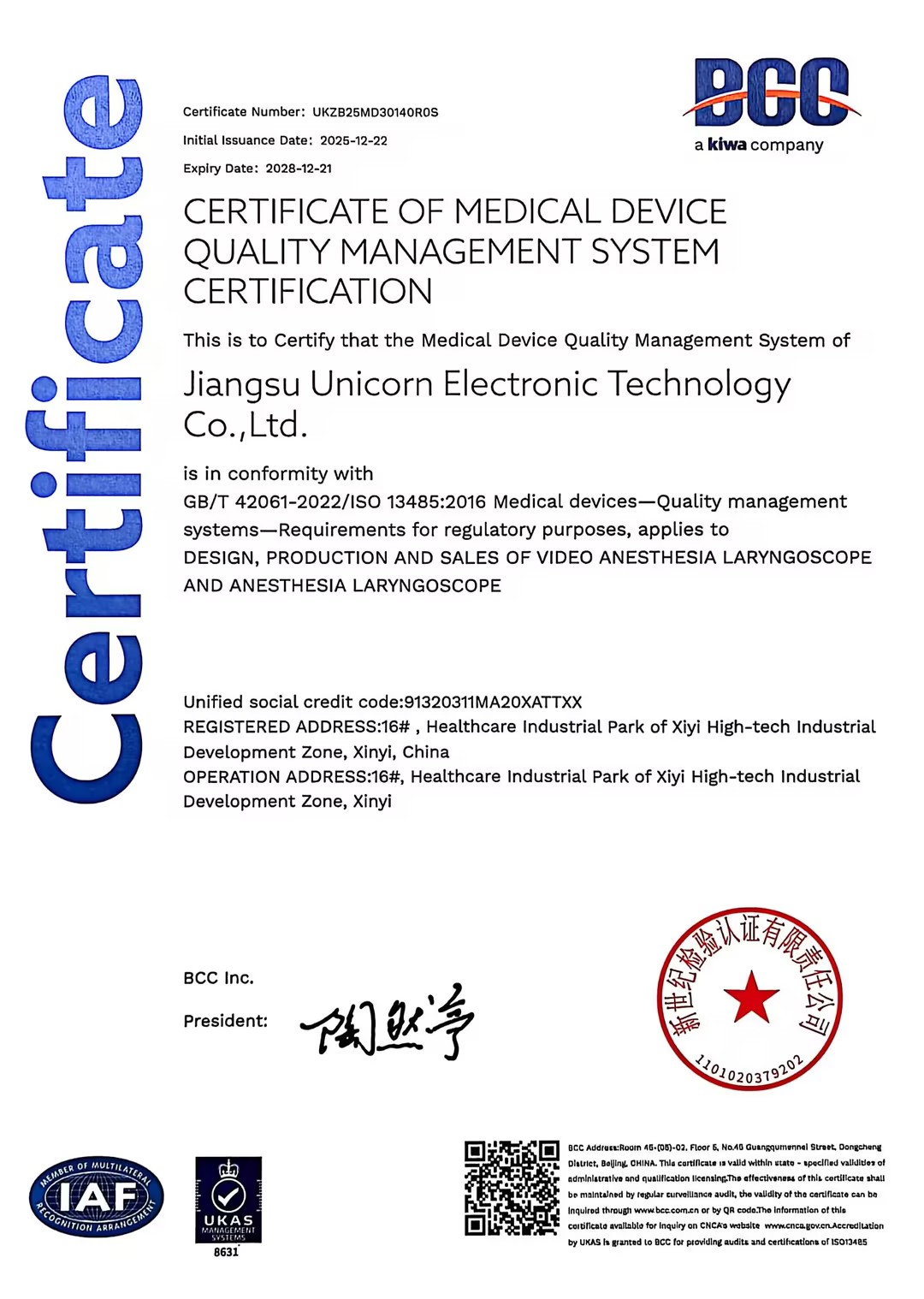
The quality-system certificate covers design, production and sales of video anesthesia laryngoscope and anesthesia laryngoscope; check the scope wording and listed models against your tender.
On market access, treat the certificate as the starting document rather than the closing one. The EU MDR requires CE marking for devices placed on the EU market, and the classification of the specific device determines what supporting evidence applies. In the United States, rigid laryngoscopes are classified under product code OGH as Class I devices, while flexible nasopharyngoscope-type systems appear under 21 CFR 874.4760 as Class II devices. Because BMS-FA, BMS-YA and BMR fall on both sides of that rigid/flexible line, a single compliance file for all three may not be sufficient for every destination market.
FAQ
Are BMS-FA, BMS-YA and BMR covered by the same certificates?
Yes, at certificate level they are listed together. The ISO 13485:2016 certificate is UKZB25MD30140R0S, issued by New Century Inspection & Certification Co., Ltd. (BCC) on 22 December 2025 and valid to 21 December 2028, with a scope covering design, production and sales of video anesthesia laryngoscope and anesthesia laryngoscope. The CE notification certificate is RPS/5400/2022, issued 7 December 2022 with validity to 6 December 2027, and Medurion S.L. is recorded as the EU authorised representative in Spain. Because the MDR requires CE marking for devices placed on the EU market, buyers should request both certificates as PDFs and confirm that the scope wording and listed products match the model being purchased and the classification that applies in the destination market.
Can Unicorn supply these models as an OEM video laryngoscope manufacturer?
Yes. Unicorn Technology operates OEM and ODM production for these laryngoscope models, with customization covering the screen logo and the power on/off logo. Production is supported by a 500-unit monthly capacity, 100% testing, remote after-sales support and export to all countries, and the company reports a 20+ engineer R&D team and workshops spanning more than 40,000 m². OEM brand owners should confirm their logo artwork, packaging specification and the model-level datasheet values for BMS-YA in the same quotation round.
What are the MOQ, payment terms and delivery terms?
The purchasing terms recorded for these three models specify an MOQ of 2 units, delivery on FOB or CIF terms, and payment of 30% deposit with 70% before shipment. Separately, the OEM/ODM capability record lists a 1-unit minimum order for production programmes. Those two figures describe different order contexts, so the correct approach is to state the intended configuration — standard model versus customized programme — and have the applicable minimum confirmed in the quotation rather than assumed.
How is acceptance testing handled, and can a sample be ordered?
The documented acceptance criterion is a pre-shipment test, which means inspection takes place before dispatch and before the 70% balance is released. Buyers should specify what is inspected — imaging output, accessories, packaging and documentation — and ask for the test result to travel with the shipping documents. With an MOQ of 2 units, a small first order functions as a practical validation step before a departmental rollout: it lets the clinical team check the field of view, depth of field and handling against their own workflow, and it lets procurement verify the delivered documentation set. A sample or quotation request can be raised directly with the Unicorn team, and the full model range is listed in the Unicorn Product Catalog (2026).
What is the production lead time, and how should a rollout be sequenced?
Typical production lead time is 30–45 days, with monthly capacity of 500 units. For single-site orders that fits a normal capital purchase cycle: confirm the model, release the 30% deposit, complete the pre-shipment test, then settle the 70% before shipment. For multi-site rollouts, sequence deliveries against the 500-unit monthly ceiling and place the BMS-YA datasheet request in the first round, since that model's optical and material values still have to be confirmed before it can be compared on specifications. To start that process, contact Alice Gong at gongting@unicornchina.top or +86 17512677733 (WhatsApp available) with the model mix, destination market and required delivery window.
Conclusion
The BMS-FA, BMS-YA and BMR decision is a three-layer decision, and the layers should be closed in order. First, format: rigid reusable video laryngoscope or flexible video laryngoscope. Second, documented performance and material: BMS-FA at 304 stainless steel blade and aluminium alloy handle with ≥3.72 lp/mm, ≥60° field of view and 20–100 mm depth of field; BMR at TPU/PPSU construction with 23.51 LP/mm, >80° field of view, 5–100 mm depth of field and >800 Lux; BMS-YA once its datasheet values are in hand. Third, the commercial and compliance frame that all three share: ISO 13485:2016 certificate UKZB25MD30140R0S, CE notification certificate RPS/5400/2022, MOQ 2 units, FOB/CIF, 30/70 payment and pre-shipment acceptance testing.
Buyers who close those layers in that order avoid the two failure modes this category produces most often — selecting a flexible or rigid format that does not match the clinical task, and accepting company-level certification as if it were model-level evidence. The remaining uncertainty is contained and answerable: one datasheet request, one certificate scope check, and one pre-shipment test.
Next Step: Sample, Quote or Catalog
Unicorn Technology supplies BMS-FA, BMS-YA and the BMR visual flexible video laryngoscope from a 40,000 m² manufacturing base with ISO 13485:2016 and CE notification certification, OEM/ODM customization and a 30–45 day lead time. Send your model mix, destination market and volume to request a quotation or a small validation order.
Contact: Alice Gong · Email gongting@unicornchina.top · Phone / WhatsApp +86 17512677733 · Web www.unicornendoscope.com
Download the Unicorn Product Catalog (2026) for the full model range and accessories.
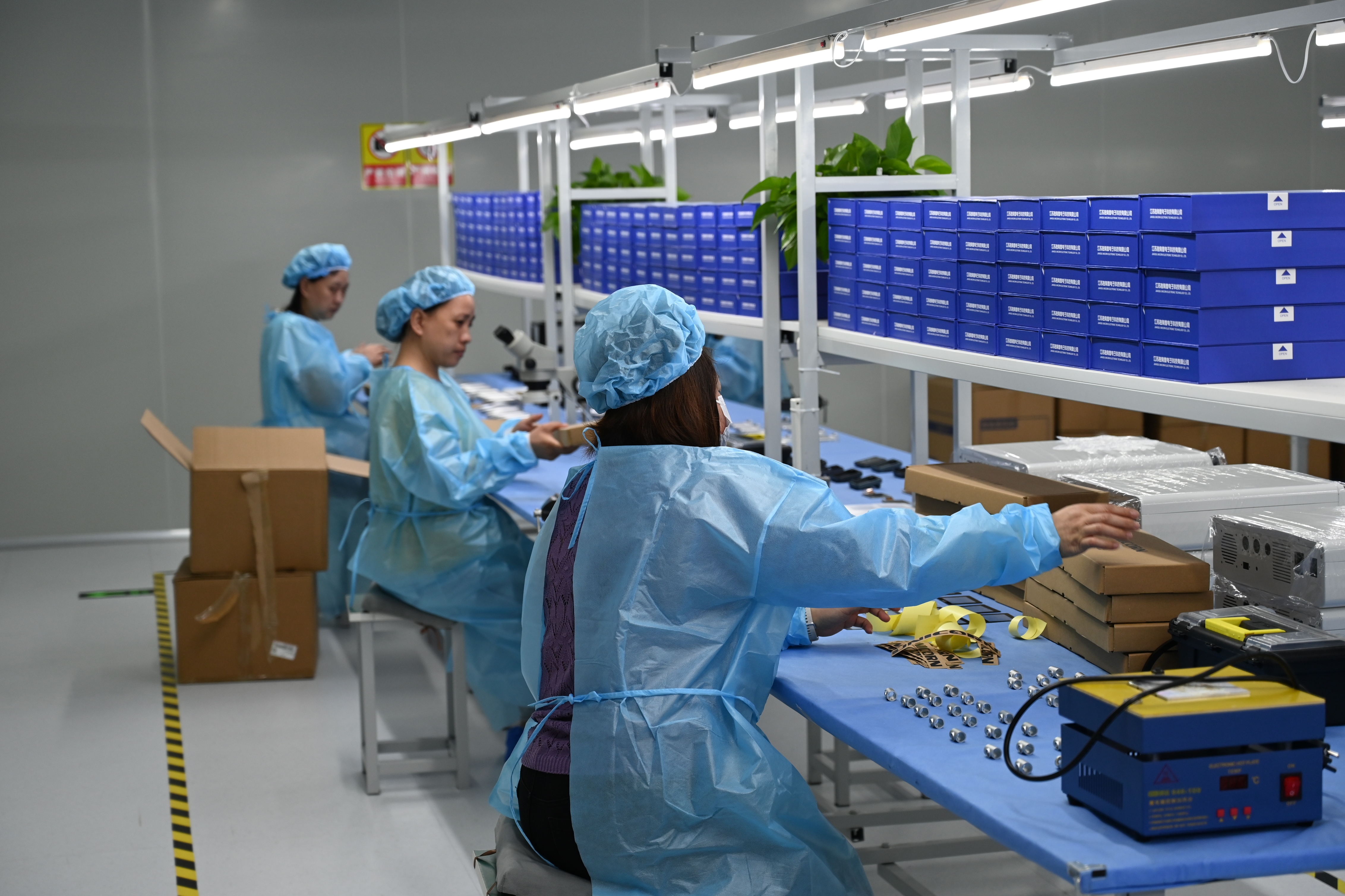
Manufacturing base for BMS-FA, BMS-YA and BMR: 500 units monthly capacity, 100% testing, 30–45 day typical lead time.
Have Questions or Need More Details?
Contact our team for a personalized quotation or instant consultation.
Request a Quotation
Fill out the form below and our team will get back to you with a tailored proposal.
WhatsApp Direct Chat
Prefer to chat in real-time? Message us on WhatsApp for instant assistance & quick answers.
- Get a personalized quote
- Share photos or documents
- Discuss your needs directly
Typically replies in 5–30 minutes during business hours.