
BMS-FA vs BMS-YA: Stainless Steel or PC Blade for Daily Anesthesia Intubation?
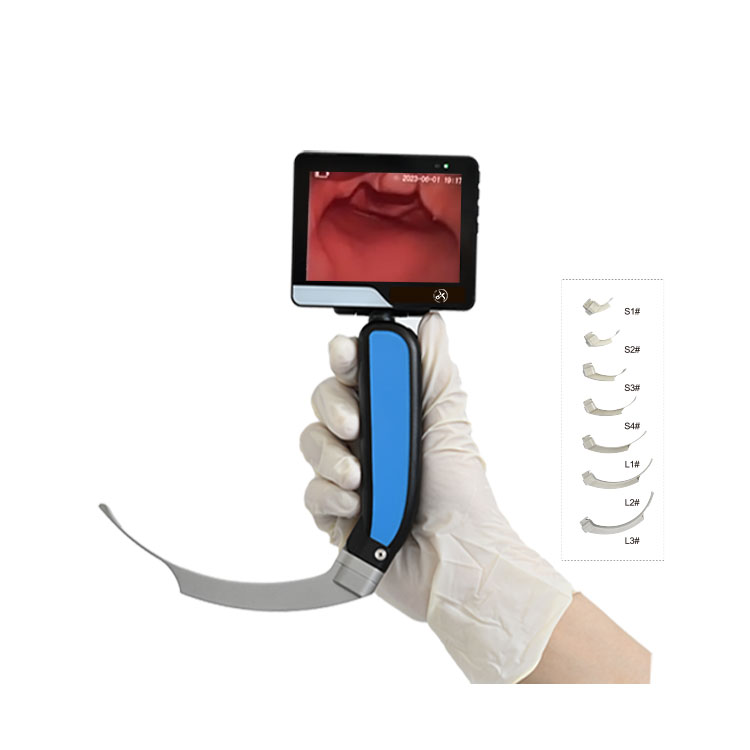
Daily anesthesia intubation is decided less by a headline specification than by three practical questions: does the blade keep its shape through your reprocessing routine, does the paperwork behind the model survive regulatory review, and do the supplier's order terms fit the way the department actually buys equipment. BMS-FA and BMS-YA are two Unicorn video laryngoscopes built on the same platform fundamentals, and the difference that matters is the blade material — 304 stainless steel on BMS-FA, PC (polycarbonate) on BMS-YA — together with the certification each model's documentation lists.
The short answer. Choose BMS-FA when a 304 stainless steel blade matches your cleaning and disinfection routine and your file needs CE (MDR) documentation. Choose BMS-YA when a PC blade suits your handling and storage practice and the documentation route your regulatory team requires is the one listed for that model. The remaining specification is shared: resolution of at least 3.72 lp/mm, a DC 3.7 V power supply, aluminium alloy handles, an MOQ of 2 units, 30% deposit with 70% before shipment, FOB or CIF delivery, and a pre-shipment acceptance test. Because those items are identical on both models, none of them decides the purchase.
Why blade material is a procurement decision, not a datasheet detail
On a video laryngoscope, the blade is the only component that enters the airway, contacts tissue and is then handled again by whoever decontaminates it. Everything else on the device — the handle, the display, the image pipeline — sits behind that contact point. That makes the blade the part most exposed to repeated cleaning chemistry, mechanical knocks in a drawer or transport case, and repeated inspection by staff who have to decide whether the device is fit for the next case.
Two consequences follow for a buying team.
- The material sets the inspection criteria. A metal blade fails visibly in a different way from a polymer blade. Deformation, edge damage and surface pitting are the things to look for on 304 stainless steel; crazing, whitening, stress cracks at the tip and locking area are the things to look for on polycarbonate. Neither list is optional if the device is reused across a daily list.
- The material interacts with your chemistry and your storage. Stainless steel and polycarbonate respond differently to disinfectant families, to elevated temperatures and to drying practice. A blade that is chemically compatible with the department's routine on paper can still deteriorate if it is stored wet or stacked under load.
For this pair of models, the stated optical resolution, the DC 3.7 V power supply and the aluminium alloy handle are the same on both sides. That is useful: it means the buyer's differentiation budget is spent on blade material, the certification evidence attached to the exact model, and the commercial terms — not on trading one model's image specification against the other's.
Industry background: why reusable video laryngoscopes still carry most of the volume
Video laryngoscopy is an airway management technique in which a camera-equipped laryngoscope blade is used to visualise the glottis on a screen rather than by direct line of sight. Within that category, hospitals choose between reusable video laryngoscope systems, single-use or disposable laryngoscope configurations, and flexible video scopes for nasal or awake work.
The reusable share remains substantial. Grand View Research reported the global video laryngoscope market at approximately USD 784.7 million in 2024, projected growth to USD 2,798.1 million by 2033 at a 14.9% CAGR, and a 65.8% share for reusable devices within the usability segment in 2024. Those figures describe market structure, not the suitability of any individual model; they do explain why a department buying for a daily anesthesia list still evaluates reusable hardware and reprocessing workflow first.
Three reference points sit behind the paperwork you will be asked to check:
- ISO 13485:2016 is the international quality management system standard for organisations involved in the lifecycle of medical devices, including manufacturers.
- ISO 7376:2020 is the international product standard for laryngoscopes used for tracheal intubation. It is a product-level document, distinct from the quality-system certificate.
- EU Regulation 2017/745 (MDR) governs medical devices placed on the EU market and requires CE marking for conformity. In the United States, rigid laryngoscopes are classified by FDA under product code OGH as Class I devices (21 CFR 868.5540).
A quality-system certificate and a product-standard test report answer different questions. Tenders sometimes ask for both, which is why the certification discussion below ends with a verification step rather than an assumption.
What BMS-FA and BMS-YA share — and what it means for the buyer
Both models are listed with a resolution of at least 3.72 lp/mm, a DC 3.7 V power supply and an aluminium alloy handle. Read together, those three points narrow the decision considerably.
Resolution of at least 3.72 lp/mm
Line pairs per millimetre is an optical resolving measurement: it describes how much fine detail the imaging chain can separate. The figure is stated as a floor (“at least”), and because both models carry the same floor, the stated resolution does not separate them. What the specification does give you is a contractual reference point for acceptance testing — if your purchase order repeats the stated figure, the pre-shipment check has something concrete to verify rather than a general impression of image sharpness. It does not, on its own, describe clinical image quality, which depends on illumination, blade geometry, screen and the airway being viewed.
DC 3.7 V power supply
A 3.7 V DC supply places both models in the same power class, so battery and charging decisions are common to the pair rather than a differentiator between them. Unicorn's laryngoscope documentation describes a low-power chip solution providing up to five hours of continuous working time on a single full charge, with low heat generation intended to reduce the risk of thermal damage to airway tissue during prolonged use. That is a platform-level description rather than a model-specific test result, so confirm the figure on the datasheet of the exact model you order and against the length of your longest list.
Aluminium alloy handle
An aluminium alloy handle is a shared housing decision, and a practical one: it is the part of a reusable video laryngoscope most often handled, docked and dropped. Buyers should still confirm the handle's stated water-resistance rating and the approved cleaning method for the handle specifically, since blade reprocessing and handle reprocessing are usually written as separate procedures.
BMS-FA: 304 stainless steel blade with CE (MDR) documentation
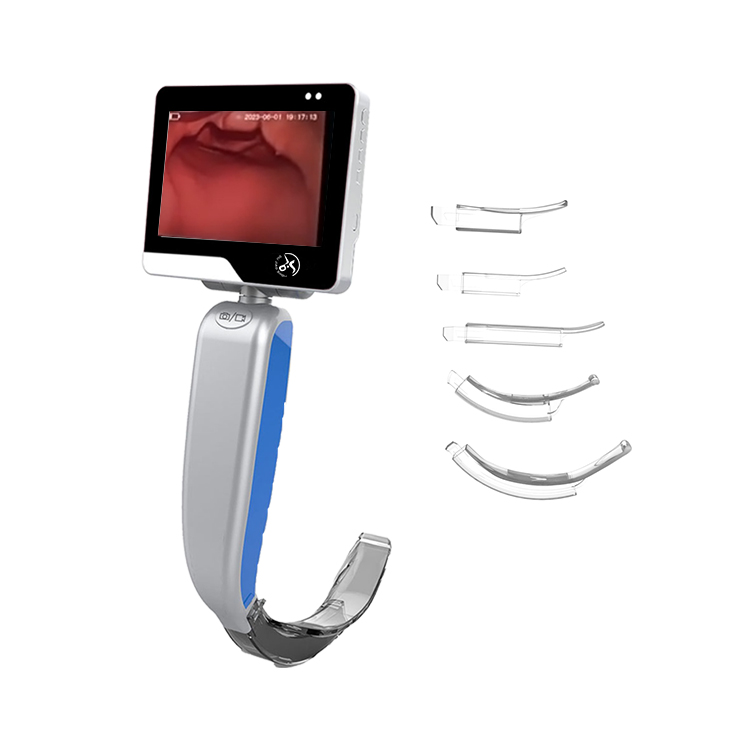
BMS-FA is specified with a 304 stainless steel blade and is documented with ISO 13485:2016 together with CE (MDR) certification.
304 is an austenitic stainless steel widely used for surgical and dental instruments. Its relevance to a reusable laryngoscope blade is behavioural rather than promotional: it tolerates repeated cleaning and disinfection cycles, resists corrosion under normal instrument care, and holds its geometry under load better than most unfilled polymers. It is also denser than polycarbonate, which changes the balance of the device in the hand and the feel of the blade during a grade of laryngoscopy where fine control matters.
For a buying team, the practical implications are these:
- Inspection is visual and dimensional. Check for bending or twist along the blade, dents at the tip, scratches that could harbour residue, and any change to the locking engagement. A metal blade that has been dropped usually shows it.
- Thermal disinfection is less of a constraint. Stainless steel tolerates higher processing temperatures than polycarbonate, which widens the set of reprocessing routes a department can use without re-validating the blade.
- Storage still matters. Metal blades resist chemical attack but not impact. Stacking blades loose in a transport case is a preventable source of tip damage on either material.
- Conductivity is a property, not automatically a risk. Metal conducts electricity; in routine airway management this is rarely the deciding factor, but it belongs on the list of questions if the device is used alongside other equipment in an unusual setup.
On the certification side, CE (MDR) documentation means the file references the EU medical device framework. That is the framework a European hospital's regulatory affairs team will expect to see for a medical device, and it is the point most often checked first in a tender clarification round.
BMS-YA: PC blade with EU 2017/746 (IVDR) documentation
BMS-YA is specified with a PC blade and is documented with ISO 13485:2016 together with EU 2017/746 (IVDR).
Polycarbonate is a transparent engineering thermoplastic with high impact strength and good dimensional stability, which is why it appears in medical housings, connectors and single-use device bodies. As a reusable blade material it behaves differently from stainless steel in four ways that a procurement team should plan around:
- Weight and balance. PC is markedly lighter, which some users notice on long lists and which shifts the device's centre of gravity.
- Chemical sensitivity. Polycarbonate is more sensitive than 304 stainless steel to certain solvent and alkaline cleaning agents and to prolonged wet storage; repeated exposure can produce crazing (fine surface cracks) or whitening. Cleaning-agent compatibility should be confirmed in writing rather than assumed from the word “disinfectant”.
- Temperature ceiling. The continuous service temperature of polycarbonate is lower than that of stainless steel, so a steam or high-temperature cycle validated for a metal blade cannot simply be transferred to a polymer one.
- Inspection criteria. Look for crazing, stress whitening, cracks radiating from the tip or the locking feature, and any loss of clarity. A cracked polymer blade is a replacement item, not a repair item.
One documentation question worth raising in writing. The two models do not cite the same EU regulation: BMS-FA is documented with CE (MDR), BMS-YA with EU 2017/746 (IVDR), which is the In Vitro Diagnostic Regulation. For a laryngoscope intended for EU clinical use, the applicable framework is MDR (Regulation (EU) 2017/745), under which medical devices placed on the EU market must comply with the regulation and bear CE marking. This does not by itself establish that either model is or is not compliant — it identifies the question to put to the supplier before the purchase order is released: which certificate, issued by which notified body, covers this exact model, in this market, under the regulation my regulatory team requires, and is it current? Ask for the certificate reference, the covered product scope and the validity date in the same message.
BMS-FA vs BMS-YA: side-by-side comparison
| Decision dimension | BMS-FA | BMS-YA |
|---|---|---|
| Blade material | 304 stainless steel | PC (polycarbonate) |
| Stated resolution | At least 3.72 lp/mm | At least 3.72 lp/mm |
| Power supply | DC 3.7 V | DC 3.7 V |
| Handle | Aluminium alloy | Aluminium alloy |
| Certification listed in documentation | ISO 13485:2016 + CE (MDR) | ISO 13485:2016 + EU 2017/746 (IVDR) |
| Minimum order quantity | 2 units | 2 units |
| Payment terms | 30% deposit, 70% before shipment | 30% deposit, 70% before shipment |
| Delivery terms | FOB or CIF | FOB or CIF |
| Pre-shipment check | Acceptance test before shipment | Acceptance test before shipment |
| Typical fit | Departments with a metal-blade reprocessing routine and a file built around CE (MDR) evidence | Departments able to control cleaning chemistry and storage for a polymer blade, with the IVDR documentation route accepted internally |
Five checks that decide between them
Step 1 — Map the daily list and the reprocessing routine
Write down how many intubations a typical anesthesia list produces, who decontaminates the device between cases, which cleaning agents are on the shelf, whether drying is forced or air, and how the device is stored between lists. This is the input that makes the material choice concrete. A department with a fixed, chemically verified routine and controlled storage is making a different decision from one where the device travels between theatres in a shared case.
Step 2 — Match the blade material to that routine
If the routine includes higher-temperature processing or a broad set of cleaning chemistries, the 304 stainless steel blade on BMS-FA removes a compatibility question. If the routine is tightly specified, polymer-compatible and dry-stored, the lighter PC blade on BMS-YA is a legitimate option — provided the inspection criteria in the previous section are written into your standard operating procedure.
Step 3 — Confirm certification scope for your market
Ask for the certificate reference, issuing body, covered product scope and validity date for the exact model, not the company. For European supply, confirm the regulation cited matches what your regulatory team requires; for US supply, note that rigid laryngoscopes sit under FDA product code OGH as Class I devices, and confirm whether any further clearance applies to the configuration you are buying. ISO 13485:2016 certification speaks to the manufacturer's quality management system; if your tender requires evidence against the laryngoscope product standard ISO 7376, request the corresponding test report separately.
Step 4 — Check the commercial terms against your purchasing rules
An MOQ of 2 units is low enough to order both models and run a side-by-side trial in your own department before committing volume — an option worth using rather than treating the comparison as a paper decision. Payment at 30% deposit with 70% before shipment front-loads most of the value into the pre-shipment window, so the acceptance test in Step 5 has to be completed and signed before that 70% is released. Under FOB the buyer arranges and pays the main carriage and insurance; under CIF the seller arranges carriage and insurance to the named destination port, while risk still transfers at shipment. Neither term changes what is in the box, so choose the term that fits your freight forwarder and insurance arrangements rather than the one that looks cheaper at quotation stage.
Step 5 — Write and run the pre-shipment acceptance test
Agree in advance what is inspected, by whom, where, and what happens if an item fails. A workable protocol for either model covers: unit count and model identity against the order; handle finish and blade seating; power-up and charge status at the rated DC 3.7 V supply; image displayed and measured resolution against the stated at-least-3.72 lp/mm figure; blade surface and tip condition; accessories, labelling and instructions for use; and copies of the certification documents for the model shipped. The supplier's own risk documentation lists raw-material chemical safety as a controlled risk area, with battery-management protection named as the control method, which is a reasonable prompt to ask for the risk management documentation relevant to the battery and to the patient-contacting blade.
Use cases: which model fits which setting
The same two models distribute differently across departments because the reprocessing environment differs, not because the clinical task does.
- Operating room, routine anesthesia lists. High case turnover and repeated handling between cases make blade durability and inspection speed the dominant criteria. Departments that process blades in a central sterile workflow, with chemical compatibility already validated for metal instruments, usually find BMS-FA the simpler route to a signed-off procedure. This is the core anesthesia laryngoscope use case.
- ICU bedside intubation. An ICU laryngoscope is often shared across a unit and cleaned by staff outside the theatre team. Where the cleaning agent is fixed and storage is controlled, the lighter PC blade on BMS-YA can suit shared-device handling — but only with a written inspection routine, because polymer damage is easier to overlook than a bent metal blade.
- Emergency and pre-hospital use. An emergency laryngoscope travels, gets stored in a vehicle or a grab bag, and is used in poor light. Impact damage risk during transport argues for clarifying how each blade type is protected in the case, and for making blade inspection part of the shift checklist rather than an annual review.
- Respiratory and endoscopy suites. Respiratory teams sometimes compare a rigid video laryngoscope against a video flexible laryngoscope. They are different device categories: a flexible video scope is a medical endoscope used for nasal and awake work, whereas BMS-FA and BMS-YA are rigid-blade video laryngoscopes for intubation. A disposable laryngoscope blade programme is a third model again, driven by single-use consumable budgeting rather than reusable-device reprocessing.
- Teaching hospitals. Where trainees handle the device, a material whose damage is visible at a glance has practical value in supervision; both blade types need the same discipline of post-use inspection.
- Distributors building a stock mix. With an MOQ of 2 units, a distributor can hold one metal-blade and one polymer-blade configuration and let the account's reprocessing routine decide the pull-through, rather than committing to a single material across a territory.
What this comparison does not establish
An honest comparison states its boundaries, and this one has several. No clinical performance data — first-pass success, time to intubation, glottic view grade or adverse events — is attached to either model in the material behind this article, so no claim of clinical superiority is made or implied. No unit price, lead time, warranty length, spare-blade price or validated reprocessing cycle count is stated for either model; those must come from a quotation and a written specification. The 3.72 lp/mm figure is a stated optical resolution floor, not a clinical image-quality benchmark. And a certification listed in a product document is a claim until the certificate reference has been checked against the issuing body's register for the exact model and market.
Supplier context: who stands behind both models
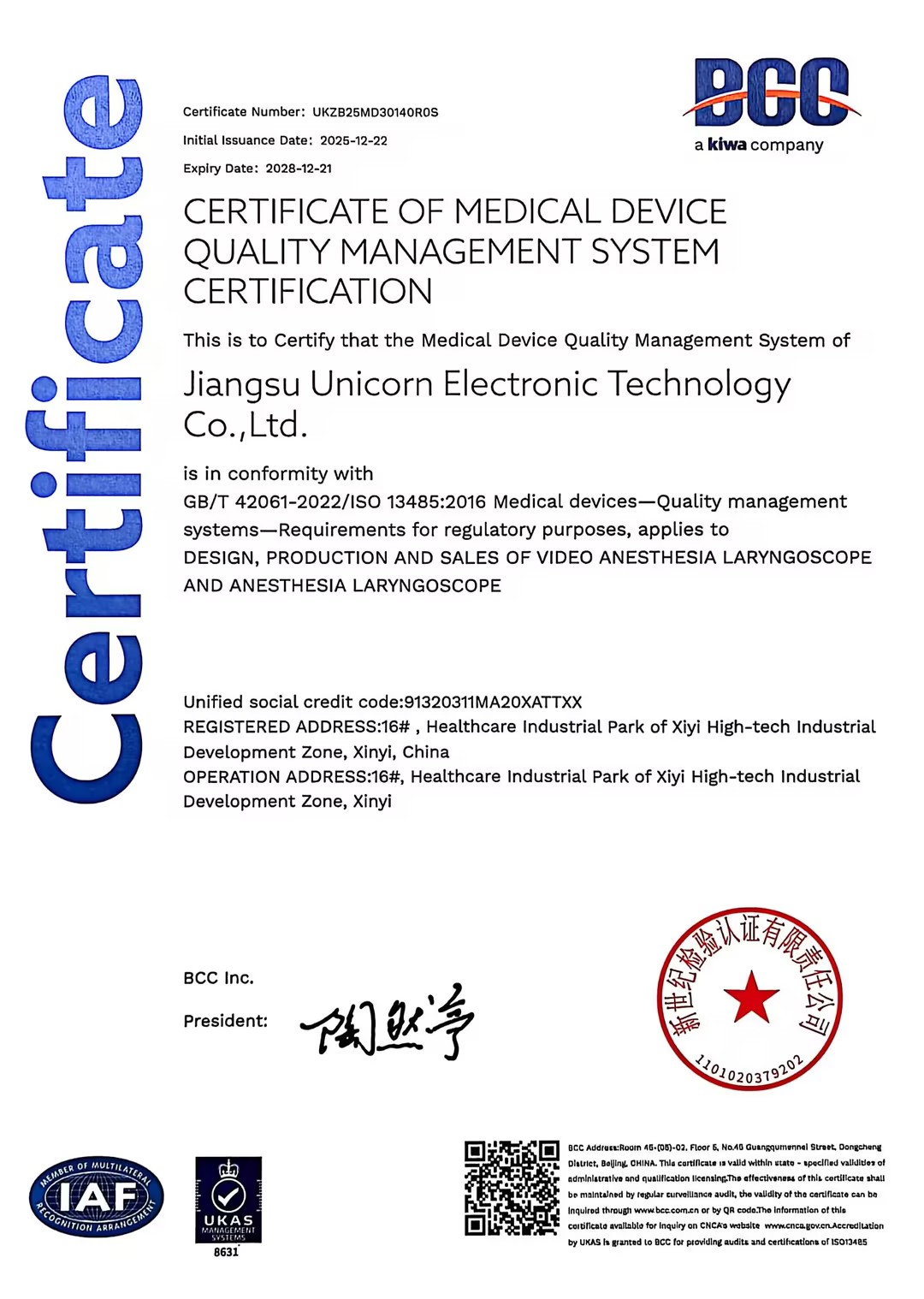
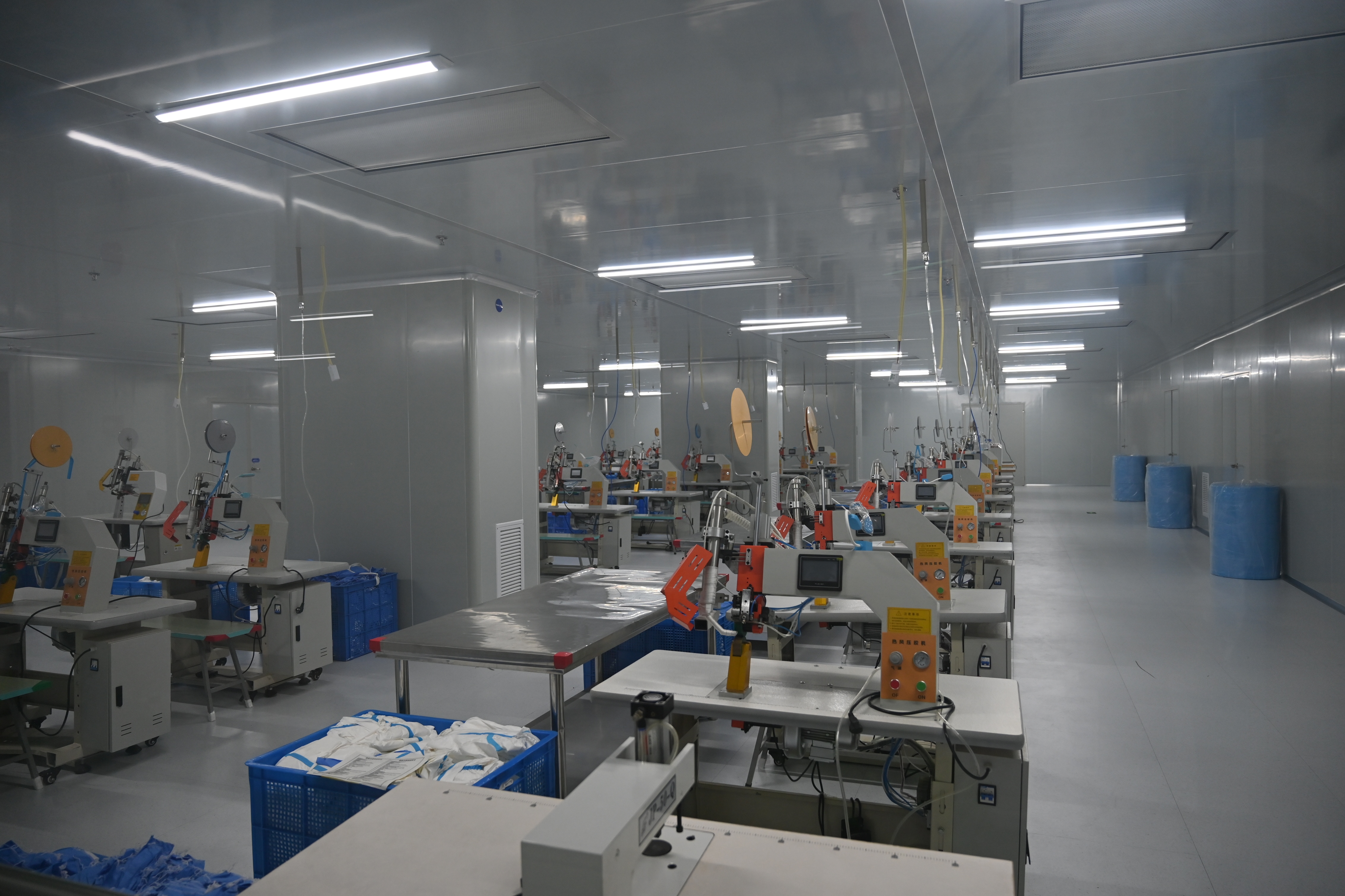
Both models come from the same manufacturer, so the supplier question is not a tie-breaker between them. Unicorn is a National High-tech Enterprise founded in 2020 that designs, manufactures and trades medical visualisation devices, including video laryngoscopes, visual flexible laryngoscopes, endoscopy systems and medical image processors. The company profile lists workshops spanning more than 40,000 m², 50–100 employees, a 20+ engineer R&D team, an annual output of 12,000 units, seven regional offices, a 70% export ratio, and ISO 9001 and ISO 13485 quality management system certification alongside FSC and CE certification. A certificate reference for ISO 13485:2016 is published alongside the company's product documentation; as with any supplier, confirm the number, scope and validity directly with the issuing body before approval. The official company site is Unicorn.
FAQ
Which manufacturer is better for laryngoscope?
There is no single better laryngoscope manufacturer independent of requirements, and for this pair the manufacturer is the same company, so the question becomes which model fits your department. Judge a manufacturer on four verifiable points rather than on brand reputation: whether the quality-system certificate (ISO 13485:2016) and the market-access documentation cover the exact model and market you are buying for, with a certificate reference you can check; whether the blade material and its documented cleaning compatibility match your reprocessing routine; whether the commercial terms — here an MOQ of 2 units, 30% deposit with 70% before shipment, and FOB or CIF delivery — fit your purchasing rules; and whether the supplier accepts a pre-shipment acceptance test with written criteria. A supplier that answers all four in writing is a stronger candidate than one that answers only the first. For BMS-FA and BMS-YA specifically, the practical test is to order two units under the stated MOQ, run both through your own cleaning routine and a live list, and let the inspection findings decide.
Conclusion: let the reprocessing routine pick the blade
BMS-FA and BMS-YA are not separated by resolution, power supply or handle material — the 3.72 lp/mm floor, the DC 3.7 V supply and the aluminium alloy handle are common to both. They are separated by what the blade is made of and what the paperwork says. A 304 stainless steel blade with CE (MDR) documentation is the lower-friction choice where metal-compatible cleaning chemistry, higher processing temperatures and visible damage inspection already define the department's routine. A PC blade with the documentation listed for BMS-YA is a workable choice where storage and cleaning chemistry are tightly controlled, weight matters, and the cited regulation has been confirmed with the supplier for the exact model and market. Identical commercial terms — MOQ 2 units, 30% deposit with 70% before shipment, FOB or CIF, and a pre-shipment acceptance test — make a two-unit side-by-side trial the cheapest way to settle the question with your own staff rather than on a datasheet.
Next step. Review the full Unicorn range, including blade configurations and accessories, in the Unicorn Product Catalog (2026), then request a two-unit sample under the stated MOQ so both blade materials can be trialled against your own reprocessing routine before volume ordering.
Have Questions or Need More Details?
Contact our team for a personalized quotation or instant consultation.
Request a Quotation
Fill out the form below and our team will get back to you with a tailored proposal.
WhatsApp Direct Chat
Prefer to chat in real-time? Message us on WhatsApp for instant assistance & quick answers.
- Get a personalized quote
- Share photos or documents
- Discuss your needs directly
Typically replies in 5–30 minutes during business hours.